


Page 233 - Statistics II for Dummies
P. 233
Chapter 12: Regression and ANOVA: Surprise Relatives!  217


                                because it describes the main part of the relationship between x and y. If the
                                slope of the line equals zero (you can’t reject Ho), you’re just left with y = a, a
                                horizontal line, and your model y = a + bx isn’t doing anything for you.

                                In ANOVA, you test to see whether the model fits by testing Ho: The means of
                                the populations are all equal versus Ha: At least two of the population means
                                aren’t equal. To do this you use an F-test (taking MST and dividing it by MSE;
                                see Chapter 9).

                                The sets of hypotheses in regression and ANOVA seem totally different, but in
                                essence, they’re both doing the same general thing: testing whether a certain
                                model fits. In the regression case, the model you want to see fit is the straight
                                line, and in the ANOVA case, the model of interest is a set of (normally distrib-
                                uted) populations with at least two different means (and the same variance).
                                Here each population is labeled as a treatment by ANOVA.

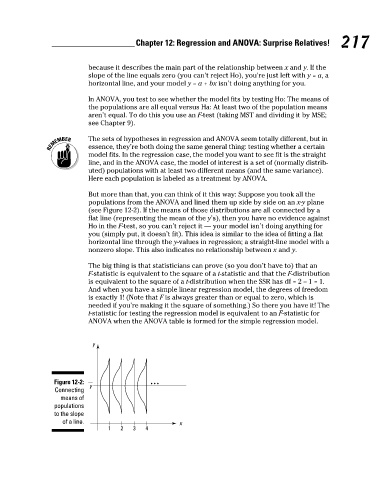
                                But more than that, you can think of it this way: Suppose you took all the
                                populations from the ANOVA and lined them up side by side on an x-y plane
                                (see Figure 12-2). If the means of those distributions are all connected by a
                                flat line (representing the mean of the y’s), then you have no evidence against
                                Ho in the F-test, so you can’t reject it — your model isn’t doing anything for
                                you (simply put, it doesn’t fit). This idea is similar to the idea of fitting a flat
                                horizontal line through the y-values in regression; a straight-line model with a
                                nonzero slope. This also indicates no relationship between x and y.

                                The big thing is that statisticians can prove (so you don’t have to) that an
                                F-statistic is equivalent to the square of a t-statistic and that the F-distribution
                                is equivalent to the square of a t-distribution when the SSR has df = 2 – 1 = 1.
                                And when you have a simple linear regression model, the degrees of freedom
                                is exactly 1! (Note that F is always greater than or equal to zero, which is
                                needed if you’re making it the square of something.) So there you have it! The
                                t-statistic for testing the regression model is equivalent to an F-statistic for
                                ANOVA when the ANOVA table is formed for the simple regression model.


                                 y


                       Figure 12-2:
                                y
                       Connecting
                        means of
                       populations
                       to the slope
                         of a line.                       x
                                      1  2   3  4


          18_466469-ch12.indd   217                                                                   7/24/09   9:45:36 AM

