


Page 529 - Sustainable Cities and Communities Design Handbook
P. 529
498  Sustainable Cities and Communities Design Handbook


            l Environment friendly: It is an alternative to burning the discarded tires or
               throwing them in a landfill.

               A German firm GIZ has partnered with Bamburi Cement Ltd. as well as
            other local businesses to form a group called Waste Tyre Management Kenya
            to help the Kenyan government adopt and implement updated waste tire
            regulations. While the cement industry is expected to be the main user of waste
            tires, the growing demand for urban mobility infrastructure, such as sidewalks,
            means that the use of waste tires may not be out of the question (NPI, 2016).
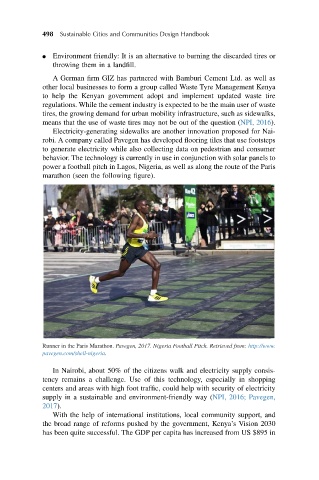
               Electricity-generating sidewalks are another innovation proposed for Nai-
            robi. A company called Pavegen has developed flooring tiles that use footsteps
            to generate electricity while also collecting data on pedestrian and consumer
            behavior. The technology is currently in use in conjunction with solar panels to
            power a football pitch in Lagos, Nigeria, as well as along the route of the Paris
            marathon (seen the following figure).


            Runner in the Paris Marathon. Pavegen, 2017. Nigeria Football Pitch. Retrieved from: http://www.
            pavegen.com/shell-nigeria.

               In Nairobi, about 50% of the citizens walk and electricity supply consis-
            tency remains a challenge. Use of this technology, especially in shopping
            centers and areas with high foot traffic, could help with security of electricity
            supply in a sustainable and environment-friendly way (NPI, 2016; Pavegen,
            2017).
               With the help of international institutions, local community support, and
            the broad range of reforms pushed by the government, Kenya’s Vision 2030
            has been quite successful. The GDP per capita has increased from US $895 in

