


Page 139 - Materials Chemistry, Second Edition
P. 139
Ch003-P373623.qxd  3/22/07  5:29 PM  Page 118
                     Sustainable Industrial Design and Waste Management
                118
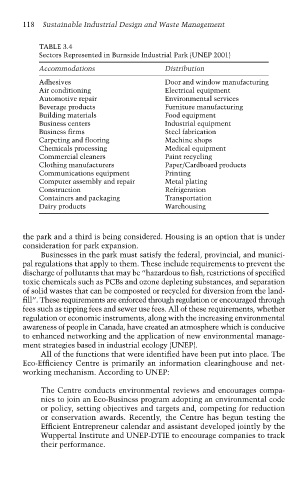
                    TABLE 3.4
                    Sectors Represented in Burnside Industrial Park (UNEP 2001)
                    Accommodations                    Distribution
                    Adhesives                         Door and window manufacturing
                    Air conditioning                  Electrical equipment
                    Automotive repair                 Environmental services
                    Beverage products                 Furniture manufacturing
                    Building materials                Food equipment
                    Business centers                  Industrial equipment
                    Business firms                     Steel fabrication
                    Carpeting and flooring             Machine shops
                    Chemicals processing              Medical equipment
                    Commercial cleaners               Paint recycling
                    Clothing manufacturers            Paper/Cardboard products
                    Communications equipment          Printing
                    Computer assembly and repair      Metal plating
                    Construction                      Refrigeration
                    Containers and packaging          Transportation
                    Dairy products                    Warehousing


                the park and a third is being considered. Housing is an option that is under
                consideration for park expansion.
                     Businesses in the park must satisfy the federal, provincial, and munici-
                pal regulations that apply to them. These include requirements to prevent the
                discharge of pollutants that may be “hazardous to fish, restrictions of specified
                toxic chemicals such as PCBs and ozone depleting substances, and separation
                of solid wastes that can be composted or recycled for diversion from the land-
                fill”. These requirements are enforced through regulation or encouraged through
                fees such as tipping fees and sewer use fees. All of these requirements, whether
                regulation or economic instruments, along with the increasing environmental
                awareness of people in Canada, have created an atmosphere which is conducive
                to enhanced networking and the application of new environmental manage-
                ment strategies based in industrial ecology (UNEP).
                     All of the functions that were identified have been put into place. The
                Eco-Efficiency Centre is primarily an information clearinghouse and net-
                working mechanism. According to UNEP:

                     The Centre conducts environmental reviews and encourages compa-
                     nies to join an Eco-Business program adopting an environmental code
                     or policy, setting objectives and targets and, competing for reduction
                     or conservation awards. Recently, the Centre has begun testing the
                     Efficient Entrepreneur calendar and assistant developed jointly by the
                     Wuppertal Institute and UNEP-DTIE to encourage companies to track
                     their performance.

