


Page 152 - Materials Chemistry, Second Edition
P. 152
Ch004-P373623.qxd  3/26/07  4:46 PM  Page 131
                                 Sustainable Development and Environmental Reform
                                         Continual improvement                     131


                         Management                                    Environment
                            review                                       policy
                                           Cleaner production
                                           technology
                                           • Source reduction
                       Checking and          * Good housekeeping    Planning
                       corrective action     * Process changes      • Environmental
                       • Monitoring and        - Better process control    aspects
                        measurement            - Equipment modification  • Legal and other
                       • Non-conformance       - Technology change   requirements
                        and corrective         - Input material change  • Objectives and
                        action             • Recycling               targets
                       • Records             * On-site recycling    • Environmental
                       • EMS audits          * Off-site recycling    management
                                           • Product modification    programs


                                                          Implementation and
                                                          operation
                                                          • Structure and responsibility
                                                          • Training, awareness and
                                                           competence
                                                          • Communication
                                                          • EMS documentation
                                                          • Document control
                                                          • Operational control
                                                          • Emergency
                                                           preparedness and
                                                           response
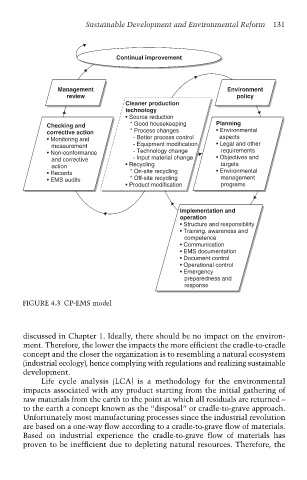
                FIGURE 4.3 CP-EMS model


                discussed in Chapter 1. Ideally, there should be no impact on the environ-
                ment. Therefore, the lower the impacts the more efficient the cradle-to-cradle
                concept and the closer the organization is to resembling a natural ecosystem
                (industrial ecology), hence complying with regulations and realizing sustainable
                development.
                     Life cycle analysis (LCA) is a methodology for the environmental
                impacts associated with any product starting from the initial gathering of
                raw materials from the earth to the point at which all residuals are returned –
                to the earth a concept known as the “disposal” or cradle-to-grave approach.
                Unfortunately most manufacturing processes since the industrial revolution
                are based on a one-way flow according to a cradle-to-grave flow of materials.
                Based on industrial experience the cradle-to-grave flow of materials has
                proven to be inefficient due to depleting natural resources. Therefore, the

