


Page 147 - Materials Chemistry, Second Edition
P. 147
Ch004-P373623.qxd  3/26/07  4:46 PM  Page 126
                     Sustainable Industrial Design and Waste Management
                126
                problem. This approach is based on the concept of adapting the best practi-
                cable environmental option (not only from technical aspects but also from
                economical and social aspects) for individual waste streams and dealing
                with waste as a byproduct. This 7Rs cradle-to-cradle rule (Regulation,
                Reduce, Reuse, Recycle, Recovery, Rethinking and Renovation) is the basis
                for sustainability. This rule will ban the disposal and treatment facilities
                and develop renewable material resources.
                     Natural resources are becoming a very crucial issue for sustainable
                development because finding new sources of raw material is becoming
                costly and difficult. Concurrently, the cost of treatment and safe disposal of
                waste is exponentially increasing and locating waste disposal sites is becom-
                ing more and more difficult. Also, the impact of waste disposal on the envi-
                ronment is significant since it might contaminate air, soil, and water. In
                order to make waste management more sustainable, it should be moved
                from the traditional life cycle analysis following a cradle-to-grave system to
                a new system without disposal facilities following a cradle-to-cradle system.


                4.2 Sustainable Development Proposed Framework

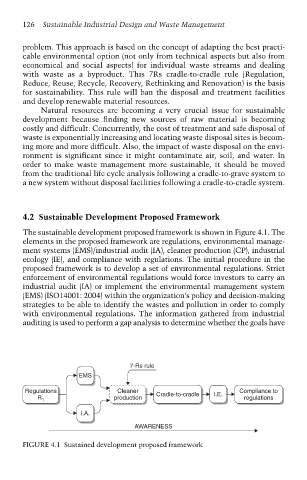
                The sustainable development proposed framework is shown in Figure 4.1. The
                elements in the proposed framework are regulations, environmental manage-
                ment systems (EMS)/industrial audit (IA), cleaner production (CP), industrial
                ecology (IE), and compliance with regulations. The initial procedure in the
                proposed framework is to develop a set of environmental regulations. Strict
                enforcement of environmental regulations would force investors to carry an
                industrial audit (IA) or implement the environmental management system
                (EMS) (ISO14001: 2004) within the organization’s policy and decision-making
                strategies to be able to identify the wastes and pollution in order to comply
                with environmental regulations. The information gathered from industrial
                auditing is used to perform a gap analysis to determine whether the goals have


                                             7-Rs rule
                               EMS
                 Regulations             Cleaner                          Compliance to
                    R 1                 production  Cradle-to-cradle  I.E.  regulations

                                I.A.
                                              AWARENESS

                FIGURE 4.1 Sustained development proposed framework

