


Page 211 - Materials Chemistry, Second Edition
P. 211
Ch005-P373623.qxd  3/22/07  5:34 PM  Page 190
                     Sustainable Industrial Design and Waste Management
                190
                biological decomposition of organic matter, under controlled conditions,
                into soil conditioner (El-Haggar et al., 1998). Aerobic fermentation is the
                decomposition of organic material in the presence of air. During the com-
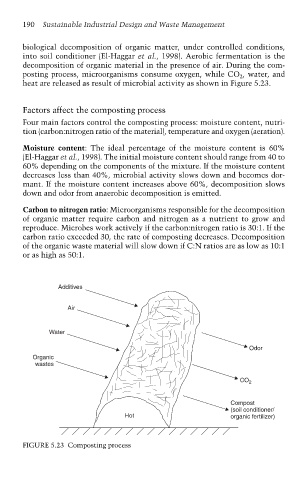
                posting process, microorganisms consume oxygen, while CO 2 , water, and
                heat are released as result of microbial activity as shown in Figure 5.23.


                Factors affect the composting process
                Four main factors control the composting process: moisture content, nutri-
                tion (carbon:nitrogen ratio of the material), temperature and oxygen (aeration).

                Moisture content: The ideal percentage of the moisture content is 60%
                (El-Haggar et al., 1998). The initial moisture content should range from 40 to
                60% depending on the components of the mixture. If the moisture content
                decreases less than 40%, microbial activity slows down and becomes dor-
                mant. If the moisture content increases above 60%, decomposition slows
                down and odor from anaerobic decomposition is emitted.

                Carbon to nitrogen ratio: Microorganisms responsible for the decomposition
                of organic matter require carbon and nitrogen as a nutrient to grow and
                reproduce. Microbes work actively if the carbon:nitrogen ratio is 30:1. If the
                carbon ratio exceeded 30, the rate of composting decreases. Decomposition
                of the organic waste material will slow down if C:N ratios are as low as 10:1
                or as high as 50:1.


                          Additives

                            Air


                       Water

                                                                            Odor
                   Organic
                   wastes

                                                                          CO 2

                                                                       Compost
                                                                       (soil conditioner/
                                           Hot                         organic fertilizer)


                FIGURE 5.23 Composting process

