


Page 212 - Materials Chemistry, Second Edition
P. 212
Ch005-P373623.qxd  3/22/07  5:34 PM  Page 191
                                                                                   191
                                 Sustainability of Municipal Solid Waste Management
                Temperature: The activity of bacteria and other microorganisms produce
                heat while decomposing (oxidizing) organic material. The ideal temperature
                range within the compost for it to be efficient varies from 32°C to 60°C. If
                the temperature is outside this range, the activity of the microorganisms
                slows down, or might be destroyed.
                     The increase of temperature while composting above 55°C, kills
                weeds, ailing microbes, and diseases including Shengella and Salmonella;
                this helps to reduce the risk of disease transmission from infected and con-
                taminated materials. The outside temperature has an effect on the compost-
                ing process. In winter, the composting process is slower than in spring and
                summer.

                Oxygen (aeration): A continuous supply of oxygen through aeration is a must
                to guarantee aerobic fermentation (decomposition). Proper aeration is needed
                to control the environment required for biological reactions and achieve the
                optimum efficiency. Different techniques can be used to perform the required
                aeration according to the composting techniques. The most common types
                of composting techniques are natural composting, forced composting, pas-
                sive composting, and vermi-composting.

                Natural composting
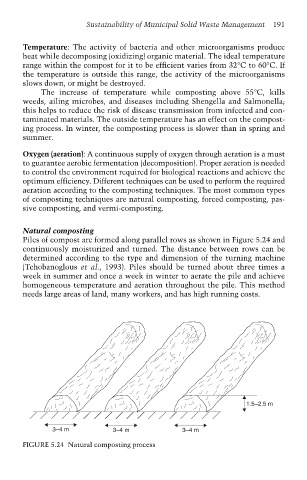
                Piles of compost are formed along parallel rows as shown in Figure 5.24 and
                continuously moisturized and turned. The distance between rows can be
                determined according to the type and dimension of the turning machine
                (Tchobanoglous  et al., 1993). Piles should be turned about three times a
                week in summer and once a week in winter to aerate the pile and achieve
                homogeneous temperature and aeration throughout the pile. This method
                needs large areas of land, many workers, and has high running costs.


                                                                            1.5–2.5 m


                        3–4 m           3–4 m              3–4 m
                FIGURE 5.24 Natural composting process

