


Page 156 - The Art of Designing Embedded Systems
P. 156
Troubleshooting Tools  143


                       I        data bus


                                                             clock
                                                             serial-in
                                                             serial-out
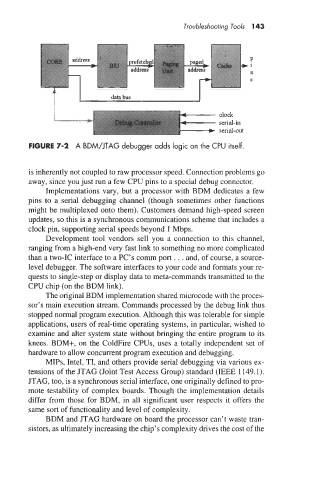
         FIGURE 7-2  A BDM/JTAG  debugger adds logic on the CPU itself.


         is inherently not coupled to raw processor speed. Connection problems go
         away, since you just run a few CPU pins to a special debug connector.
              Implementations  vary, but a processor  with BDM dedicates a few
         pins to a  serial debugging  channel  (though sometimes other  functions
         might be multiplexed onto them). Customers demand high-speed screen
         updates, so this is a synchronous communications scheme that includes a
         clock pin, supporting serial speeds beyond 1 Mbps.
              Development tool  vendors  sell you  a  connection to  this  channel,
         ranging from a high-end very fast link to something no more complicated
         than a two-IC interface to a PC’s comm port . . . and, of course, a source-
         level debugger. The software interfaces to your code and formats your re-
         quests to single-step or display data to meta-commands transmitted to the
         CPU chip (on the BDM link).
              The original BDM implementation shared microcode with the proces-
         sor’s main execution stream. Commands processed by the debug link thus
         stopped normal program execution. Although this was tolerable for simple
         applications, users of real-time operating systems, in particular, wished to
         examine and alter system state without bringing the entire program to its
         knees. BDM+, on the ColdFire CPUs, uses  a totally independent set of
         hardware to allow concurrent program execution and debugging.
              MIPS, Intel, TI, and others provide serial debugging via various ex-
         tensions of the JTAG (Joint Test Access Group) standard (IEEE 1149.1).
         JTAG, too, is a synchronous serial interface, one originally defined to pro-
         mote testability  of complex boards.  Though the implementation  details
         differ from those for BDM, in all  significant user  respects  it offers the
         same sort of functionality and level of complexity.
              BDM and JTAG hardware on board the processor can’t waste tran-
         sistors, as ultimately increasing the chip’s complexity drives the cost of the

