


Page 34 - The Art of Designing Embedded Systems
P. 34
Disciplined Development  2 1

             programmer,  maybe years from now, tries to change  a line. When pre-
             sented with a screen full of warnings, he’ll have no idea if these are normal
             or a symptom of a newly induced problem.
                  Do the inspection post-compile  but pre-test. Developers constantly
             ask if they can do “a bit” of testing before the inspection-surely  only to
             reduce the embarrassment of finding dumb mistakes in front of their peers.
             Sorry, but testing first negates most of the benefits. First, inspection is the
             cheapest way to find bugs; the entire point of it is to avoid testing. Second,
             all too often a pre-tested module never gets inspected. “Well, that sucker
             works OK; why waste time inspecting it?”
                  Tune your inspection checklist. As you learn about the types of de-
             fects you’re finding, add those to the checklist so the inspection process
             benefits from actual experience.
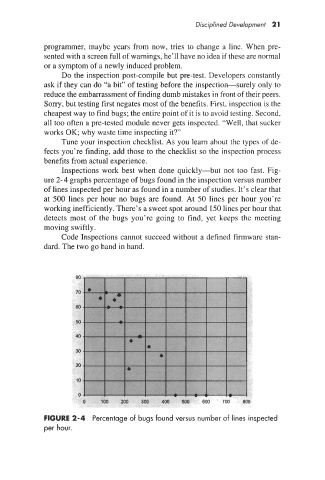
                  Inspections work best when done quickly-but   not too fast. Fig-
             ure 2-4 graphs percentage of bugs found in the inspection versus number
             of lines inspected per hour as found in a number of studies. It’s clear that
             at 500 lines per hour no bugs  are found.  At 50 lines per hour  you’re
             working inefficiently. There’s a sweet spot around 150 lines per hour that
             detects most of  the bugs  you’re  going to find,  yet keeps  the meeting
             moving swiftly.
                  Code Inspections cannot succeed without a defined firmware stan-
             dard. The two go hand in hand.


                      80
                      70

                      60
                      50

                      40

                      30
                      20
                      10

                       0
                        0    100   200   300   400   500   600   700   800

             FIGURE 2-4  Percentage of bugs found versus number of lines inspected
             per hour.

