


Page 38 - The Art of Designing Embedded Systems
P. 38
Disciplined Development  25


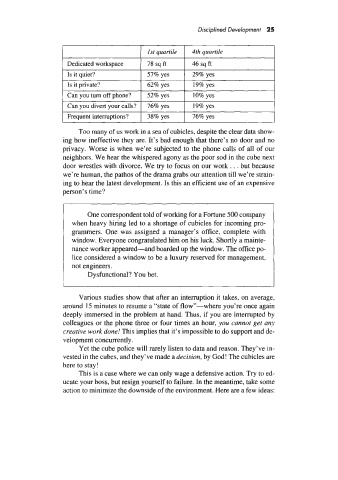
                                              1st quartile   4th quartile
                      Dedicated workspace     78 sq ft      46 sq ft
                      Is it quiet?            57% yes       29% yes
                      Is it private?          62% yes       19% yes
                      Can you turn off phone?   52% yes     10% yes

                      Can you divert your calls?   76% yes   19% yes
                      Frequent interruptions?   38% yes     76% yes

                         Too many of us work in a sea of cubicles, despite the clear data show-
                    ing how ineffective they are. It’s bad enough that there’s no door and no
                    privacy. Worse is when we’re subjected to the phone calls of all of our
                    neighbors. We hear the whispered agony as the poor sod in the cube next
                    door wrestles with divorce. We try to focus on our work. . . but because
                    we’re human, the pathos of the drama grabs our attention till we’re strain-
                    ing to hear the latest development. Is this an efficient use of an expensive
                    person’s time?


                            One correspondent told of working for a Fortune 500 company
                       when heavy hiring led to a shortage of cubicles for incoming pro-
                       grammers. One was assigned a  manager’s  office, complete with
                       window. Everyone congratulated him on his luck. Shortly a mainte-
                       nance worker appeared-and  boarded up the window. The office po-
                       lice considered a window to be a luxury reserved for management,
                       not engineers.
                            Dysfunctional? You bet.


                         Various studies show that after an interruption it takes, on average,
                    around 15 minutes to resume a “state of flow”-where  you’re once again
                    deeply immersed in the problem at hand. Thus, if you are interrupted by
                    colleagues or the phone three or four times an hour, you cannot get any
                    creative work done! This implies that it’s impossible to do support and de-
                    velopment concurrently.
                         Yet the cube police will rarely listen to data and reason. They’ve in-
                    vested in the cubes, and they’ve made a decision, by God! The cubicles are
                    here to stay!
                         This is a case where we can only wage a defensive action. Try to ed-
                    ucate your boss, but resign yourself to failure. In the meantime, take some
                    action to minimize the downside of the environment. Here are a few ideas:

