


Page 40 - The Art of Designing Embedded Systems
P. 40
Disciplined Development  27


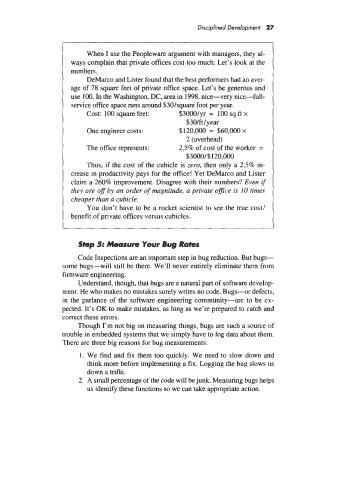
                           When I use the Peopleware argument with managers, they al-
                       ways complain that private offices cost too much. Let’s look at the
                       numbers.
                            DeMarco and Lister found that the best performers had an aver-
                       age of 78 square feet of private office space. Let’s be generous and
                       use 100. In the Washington, DC, area in 1998, nice-very   nice-full-
                       service office space runs around $3O/square foot per year.
                           Cost: 100 square feet:       $3000/yr  =  100sqft x
                                                          $30/ft/year
                            One engineer costs:         $120,000 = $60,000 x
                                                          2 (overhead)
                           The office represents:       2.5% of cost of the worker  =
                                                          $3OO0/$120,000
                           Thus, if the cost of the cubicle is zero, then only a 2.5% in-
                       crease in productivity pays for the office! Yet DeMarco and Lister
                       claim a 260% improvement. Disagree with their numbers? Even if
                       the?, are off by an order of magnitude, a private ofice is 10  times
                       cheaper than a cubicle.
                            You don’t have to be a rocket  scientist to see the true cost/
                       benefit of private offices versus cubicles.


                         Step 5: Mearum Your Bug Rates
                         Code Inspections are an important step in bug reduction. But bugs-
                    some bugs-will   still be there. We’ll never entirely eliminate them from
                    firmware engineering.
                         Understand, though, that bugs are a natural part of software develop-
                    ment. He who makes no mistakes surely writes no code. Bugs-r   defects,
                    in  the parlance of  the  software engineering community-are  to be ex-
                    pected. It’s OK to make mistakes, as long as we’re prepared to catch and
                    correct these errors.
                         Though I’m not big on measuring things, bugs are such a source of
                    trouble in embedded systems that we simply have to log data about them.
                    There are three big reasons for bug measurements:

                         1.  We find and fix them too quickly. We need to slow down and
                            think more before implementing a fix. Logging the bug slows us
                            down a trifle.
                         2.  A small percentage of the code will be junk. Measuring bugs helps
                            us identify these functions so we can take appropriate action.

