


Page 54 - The Art of Designing Embedded Systems
P. 54
Stop Writing Big  Programs  41


                    frame, one CPU, one program, is doing many disparate activities that only
                    eventually serve a common goal.
                         Not enough horsepower? Toss in a 32-bitter. Crank up the clock rate.
                    Cut out wait states.
                         Why do we continue to emulate the antiquated notion of “big iron”-
                    even if the central machine is only an 805 l? Mainframes were long ago re-
                    placed by distributed workstations.
                         A single big CPU running the entire application implies that there’s
                    a huge  program  handling  everything.  We  know  that  big  programs  are
                    bad-they   cost too much to develop.
                         It’s usually cheaper to add more CPUs merely for the sake of simpli-
                    fying the software.
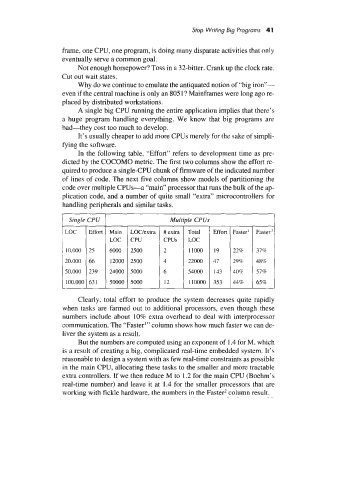
                         In  the following table, “Effort” refers to development time as pre-
                    dicted by the COCOMO metric. The first two columns show the effort re-
                    quired to produce a single-CPU chunk of firmware of the indicated number
                    of  lines of code. The next five columns show models of partitioning the
                    code over multiple CPUs-a  “main” processor that runs the bulk of the ap-
                    plication code, and a number of  quite small “extra” microcontrollers for
                    handling peripherals and similar tasks.

                      Single CPU                     Multiple CPUs
                                                   #extra   Total   Effort  Faster I   Faster’


                     10.000  25                                         229    379,
                     20.000   66                          22000         29%
                     50,000   239                         54000   133   40%
                            631
                     100,000
                                                   12
                    1 11oooo  353                                       44%    65%
                         Clearly, total effort  to  produce the system decreases quite rapidly
                    when tasks are  farmed  out to additional  processors,  even though  these
                    numbers include  about  10% extra overhead  to deal  with  interprocessor
                    communication. The “Faster’” column shows how much faster we can de-
                    liver the system as a result.
                         But the numbers are computed using an exponent of 1.4 for M, which
                    is a result of creating a big, complicated real-time embedded system. It’s
                    reasonable to design a system with as few real-time constraints as possible
                    in the main CPU, allocating these tasks to the smaller and more tractable
                    extra controllers. If we then reduce M to  1.2 for the main CPU (Boehm’s
                    real-time number) and leave it at  1.4 for the smaller processors that are
                    working with fickle hardware. the numbers in the Faster2 column result.

