


Page 55 - The Art of Designing Embedded Systems
P. 55
42  THE ART OF  DESIGNING EMBEDDED SYSTEMS


                 To put this in another context, getting a 1OOK LOC program to market
            65% faster means we’ve  saved over 200  man-months of  development
            (using the fastest of  Bell Lab’s production rates), or something like $2
            million.
                 Don’t believe me? Cut the numbers by  a factor of  10. That’s still
            $200,000 in engineering that does not have to get amortized into the cost
            of the product. The product also gets to market much, much faster, and ide-
            ally it generates substantially more sales revenue.
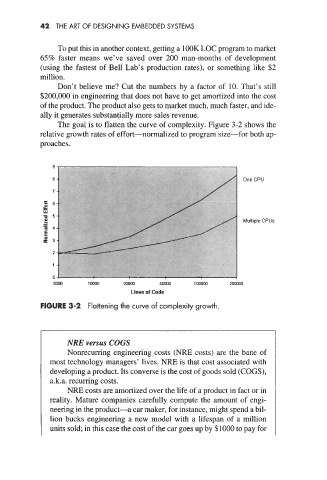
                 The goal is to flatten the curve of complexity. Figure 3-2 shows the
            relative growth rates of effort-normalized  to program size-for  both ap-
            proaches.


                                                                    One CPU


                                                                    Multiple CPUs


                5000     10000     20000     50000    100000    200000
                                     Lines of Code
            FIGURE 3-2 Flattening the curve of complexity growth.


                    NRE versus COGS
                    Nonrecurring engineering costs (NRE costs) are the bane of
               most technology managers’ lives. NRE is that cost associated with
               developing a product. Its converse is the cost of goods sold (COGS),
               a.k.a. recurring costs.
                    NRE costs are amortized over the life of a product in fact or in
               reality. Mature companies carefully compute the amount of  engi-
               neering in the product-a  car maker, for instance, might spend a bil-
               lion bucks engineering a new model with a lifespan of  a million
               units sold; in this case the cost of the car goes up by $1000 to pay for

