


Page 80 - The Art of Designing Embedded Systems
P. 80
Real Time Means Right Now!  67

                         Most of these sorts of difficulties stem from slow ISRs, or from code
                    that leaves interrupts off for too long. Be wary of any code that executes a
                    disable-interrupt  instruction. There’s rarely a good reason  for it; this is
                    usually an indication of sloppy software.
                         It’s rather difficult to find a chunk of code that leaves interrupts off.
                    The ancient 8080 had a wonderful pin that showed interrupt state all of the
                    time. It was easy to watch this on the scope and look for interrupts that
                    came during that period. Now, having advanced so far, we have no such
                    easy troubleshooting aids. About the best one can do is watch the INTR
                    pin. If  it stays asserted for long periods of  time, and if  it’s properly de-
                    signed (i.e., stays asserted until INTA), then interrupts are certainly off.
                         One design  rule of  thumb  will  help  minimize  missing  interrupts:
                    reenable interrupts in ISRs at the earliest safe spot.

                         Reentrancy Problems

                         Well-designed  interrupt  handlers  are  largely  reentrant.  Reentrant
                    functions-a.k.a.  “pure code”-are   often falsely thought to be any code
                    that does not modify itself. Too many programmers feel that if they sim-
                    ply  avoid self-modifying code, their routines are guaranteed to be reen-
                    trant, and thus interrupt-safe. Nothing could be further from the truth.
                         A function is reentrant if, while it is being executed, it can be rein-
                    voked by itself, or by any other routine.
                         Suppose your main-line routine and the ISRs are all coded in C. The
                    compiler will certainly invoke runtime functions to support floating-point
                    math, VO, string manipulations, etc. If  the runtime package is only par-
                    tially reentrant, then your ISRs may very well corrupt the execution of the
                    main line code. This problem is common, but is virtually impossible to
                    troubleshoot,  since  symptoms result  only  occasionally  and  erratically.
                    There’s nothing more ulcer-inducing than isolating a bug that manifests it-
                    self only occasionally, and with totally different characteristics each time.
                         Sometimes we’re tempted to cheat and write a nearly pure routine. If
                    your ISR merely increments a global 32-bit value, maybe to maintain time,
                    it would seem legal to produce code that does nothing more than a quick
                    and dirty increment. Beware! Especially when writing code on an 8- or 16-
                    bit processor, remember that the C compiler will surely generate several
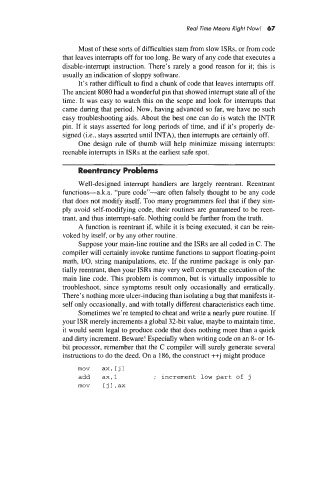
                    instructions to do the deed. On a 186, the construct ++j might produce

                         mov    ax, [jl
                         add    ax,l            ; increment low part  of j
                         mov    [jl ,ax

