


Page 110 - The Handbook of Persuasion and Social Marketing
P. 110
Persuasion in the Political Context                                103


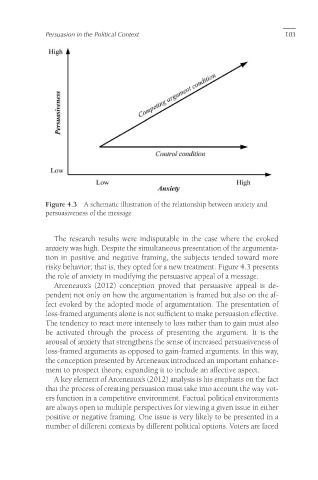
               Figure 4.3  A schematic illustration of the relationship between anxiety and
               persuasiveness of the message


                  The research results were indisputable in the case where the evoked
               anxiety was high. Despite the simultaneous presentation of the argumenta-
               tion in positive and negative framing, the subjects tended toward more
               risky behavior; that is, they opted for a new treatment. Figure 4.3 presents
               the role of anxiety in modifying the persuasive appeal of a message.
                  Arceneaux’s (2012) conception proved that persuasive appeal is de-
               pendent not only on how the argumentation is framed but also on the af-
               fect evoked by the adopted mode of argumentation. The presentation of
               loss-framed arguments alone is not sufficient to make persuasion effective.
               The tendency to react more intensely to loss rather than to gain must also
               be activated through the process of presenting the argument. It is the
               arousal of anxiety that strengthens the sense of increased persuasiveness of
               loss-framed arguments as opposed to gain-framed arguments. In this way,
               the conception presented by Arceneaux introduced an important enhance-
               ment to prospect theory, expanding it to include an affective aspect.
                  A key element of Arceneaux’s (2012) analysis is his emphasis on the fact
               that the process of creating persuasion must take into account the way vot-
               ers function in a competitive environment. Factual political environments
               are always open to multiple perspectives for viewing a given issue in either
               positive or negative framing. One issue is very likely to be presented in a
               number of different contexts by different political options. Voters are faced

