


Page 108 - The Handbook of Persuasion and Social Marketing
P. 108
Persuasion in the Political Context                                101

               or a negative frame; it plays a far more important role in that it modifies
               the cognitive process  of experiencing  a given  event and its persuasive
               power (see Albarracín & Kumkale, 2003; Forgas, 2008). Therefore, one
               can state that the increased alertness in experiencing the argumentation
               presented in a negative frame is caused by the arousal of negative affect.
               This is an intuitively unquestionable claim; unless the negative message
               fails to cause anxiety, its persuasive appeal should not exceed the appeal of
               the positive message, the content of which does not evoke negative affect.
                  This relatively complex psychological process, which activates the in-
               terdependencies between cognition, motivation, and affect, helps explain
               the mechanism of the gradable persuasive appeal of the information pre-
               sented by means of negative or positive framing. If any of these elements
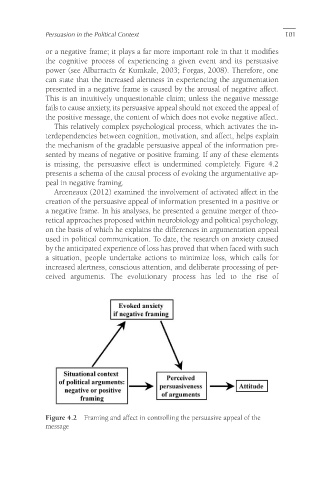
               is  missing,  the  persuasive  effect  is  undermined  completely.  Figure  4.2
               presents a schema of the causal process of evoking the argumentative ap-
               peal in negative framing.
                  Arceneaux (2012) examined the involvement of activated affect in the
               creation of the persuasive appeal of information presented in a positive or
               a negative frame. In his analyses, he presented a genuine merger of theo-
               retical approaches proposed within neurobiology and political psychology,
               on the basis of which he explains the differences in argumentation appeal
               used in political communication. To date, the research on anxiety caused
               by the anticipated experience of loss has proved that when faced with such
               a situation, people undertake actions to minimize loss, which calls for
               increased alertness, conscious attention, and deliberate processing of per-
               ceived  arguments.  The  evolutionary  process  has  led  to  the  rise  of


               Figure 4.2  Framing and affect in controlling the persuasive appeal of the
               message

