


Page 117 - The Handbook of Persuasion and Social Marketing
P. 117
110                           The Handbook of Persuasion and Social Marketing

              determine whether it will increase or decrease the reliability of Polish macr-
              oeconomic policy.

              The first stance emphasizes advantages of adopting the common cur-
            rency, the second focuses on losses, and the third is an ambiguous posi-
            tion. Obviously, voters supporting one of the two first stances will
            presumably opt for the politician whose stance agrees with theirs. However,
            it is intriguing to speculate how neutral voters are likely to behave, be-
            cause they have no clearly defined stance on the adoption of the common
            currency. In the light of the assumption concerning the electoral market
            segmentation via issues, it is this third group of voters that constitutes a
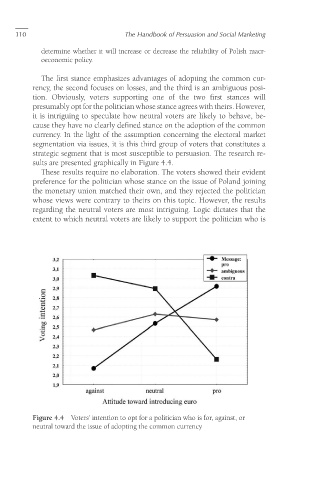
            strategic segment that is most susceptible to persuasion. The research re-
            sults are presented graphically in Figure 4.4.
              These results require no elaboration. The voters showed their evident
            preference for the politician whose stance on the issue of Poland joining
            the monetary union matched their own, and they rejected the politician
            whose views were contrary to theirs on this topic. However, the results
            regarding the neutral voters are most intriguing. Logic dictates that the
            extent to which neutral voters are likely to support the politician who is


            Figure 4.4  Voters’ intention to opt for a politician who is for, against, or
            neutral toward the issue of adopting the common currency

