


Page 120 - The Resilient Organization
P. 120
Resourceful, Robust, and Adaptive                                    107


          Medici to claim action to be in the city’s interests while benefiting his own
          purposes. Such ambiguity allowed that “everything was done in a response
          to a flow of requests that, somehow or other, ‘just so happened’ to serve
          Cosimo’s extremely multiple interests” (p. 1263). Being able to entertain
          such a grand number of varied interests is kind of robust accomplishment in
          itself; yet the key to behavioral robustness here is the multivocality—“the
          fact that single actions can be interpreted coherently from multiple perspec-
          tives simultaneously, the fact that single actions can be moves in many games
          at once, and the fact that public and private motivations cannot be parsed”
          (p. 1263). Thus it is crucial for robust action “not to pursue any specific
          goals” (p. 1264) or lock the organization into the pursuit of a particular goal
          in case of change. “Victory, in Florence, in chess, or in go means locking in
          others, but not yourself, to goal-oriented sequences of strategic play that
          become predictable thereby” (p. 1264). Robust behavior is keeping the
          options open while making it difficult to discern one’s ultimate motives—
          selfish or otherwise—for any particular move.


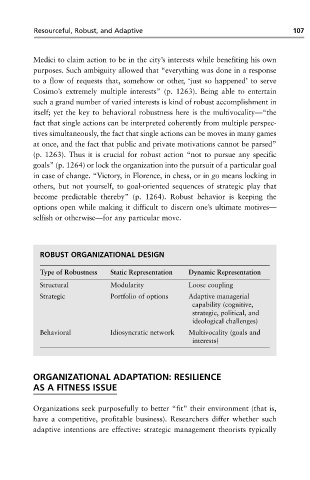
            ROBUST ORGANIZATIONAL DESIGN

            Type of Robustness  Static Representation  Dynamic Representation
            Structural        Modularity           Loose coupling
            Strategic         Portfolio of options  Adaptive managerial
                                                    capability (cognitive,
                                                    strategic, political, and
                                                    ideological challenges)
            Behavioral        Idiosyncratic network  Multivocality (goals and
                                                    interests)


          ORGANIZATIONAL ADAPTATION: RESILIENCE
          AS A FITNESS ISSUE

          Organizations seek purposefully to better “fit” their environment (that is,
          have a competitive, profitable business). Researchers differ whether such
          adaptive intentions are effective: strategic management theorists typically

