


Page 199 - The Resilient Organization
P. 199
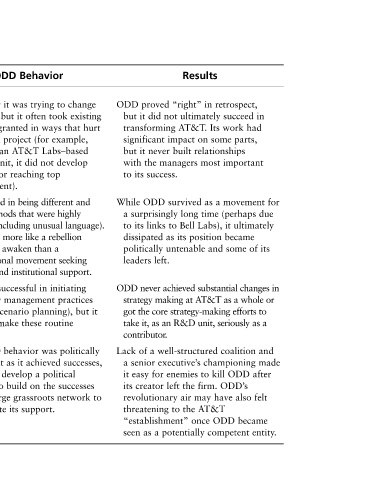
ODD proved “right” in retrospect,   transforming AT&T. Its work had significant impact on some parts,  but it never built relationships   to its success.  dissipated as its position became  leaders left.  contributor.  its creator left the firm. ODD’s  threatening to the AT&T


               Results  but it did not ultimately succeed in  with the managers most important   While ODD survived as a movement for a surprisingly long time (perhaps due to its links to Bell Labs), it ultimately  politically untenable and some of its  ODD never achieved substantial changes in strategy making at AT&T as a who


                    ODD knew it was trying to change  its overall project (for example, acting as an AT&T Labs–based support unit, it did not develop strategy for reaching top  management). ODD reveled in being different and using methods that were highly  ODD was more like a rebellion seeking to awaken than a constitutional m

               ODD Behavior  the rules, but it often took existing rules for granted in ways that hurt  original (including unusual language).  political and institutional support.  some new management practices (such as scenario planning), but it  Some ODD behavior was politically astute, but as it achieved successes,  strate


           Key Lessons of Institutionalism for Activists


                    Institutions are rules of the  Luckmann, 1966) and   that create a logic of  Olsen, 1989).  1988).  Institutions are formed not so  Luckmann, 1966).  Supporters must form a  agenda setting and “goallessness” (Fligstein,  1997).
               Literature  game (North, 1990) that are taken for granted (Berger &  appropriateness (March &  Institutional entrepreneurship is highly political (DiMaggio,  much by deliberate decision as by habitualization, objectification, and sedimentation (Berger &  “center” or “core” supporting new institutions through the


           Table 13.1  Topic  Nature of institutions  Nature of   institutional  entrepreneurship  Process of   institutional change  Institutional  entrepreneurship skills


                                       ■ 185 ■

