


Page 241 - The Resilient Organization
P. 241
226                                                            Conclusion


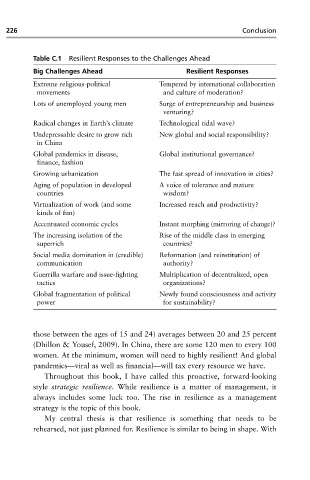
          Table C.1  Resilient Responses to the Challenges Ahead
          Big Challenges Ahead                     Resilient Responses
          Extreme religious-political      Tempered by international collaboration
           movements                        and culture of moderation?
          Lots of unemployed young men     Surge of entrepreneurship and business
                                            venturing?
          Radical changes in Earth’s climate  Technological tidal wave?
          Undepressable desire to grow rich   New global and social responsibility?
           in China
          Global pandemics in disease,     Global institutional governance?
           finance, fashion
          Growing urbanization             The fast spread of innovation in cities?
          Aging of population in developed   A voice of tolerance and mature
           countries                        wisdom?
          Virtualization of work (and some   Increased reach and productivity?
           kinds of fun)
          Accentuated economic cycles      Instant morphing (mirroring of change)?
          The increasing isolation of the   Rise of the middle class in emerging
           superrich                        countries?
          Social media domination in (credible)   Reformation (and reinstitution) of
           communication                    authority?
          Guerrilla warfare and issue-fighting   Multiplication of decentralized, open
           tactics                          organizations?
          Global fragmentation of political   Newly found consciousness and activity
           power                            for sustainability?


          those between the ages of 15 and 24) averages between 20 and 25 percent
          (Dhillon & Yousef, 2009). In China, there are some 120 men to every 100
          women. At the minimum, women will need to highly resilient! And global
          pandemics—viral as well as financial—will tax every resource we have.
             Throughout this book, I have called this proactive, forward-looking
          style strategic resilience. While resilience is a matter of management, it
          always includes some luck too. The rise in resilience as a management
          strategy is the topic of this book.
             My central thesis is that resilience is something that needs to be
          rehearsed, not just planned for. Resilience is similar to being in shape. With

