


Page 174 - Welding of Aluminium and its Alloys
P. 174
Other welding processes   157


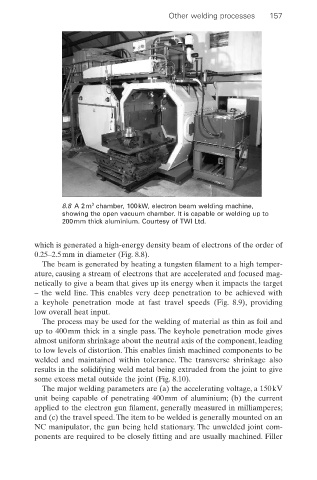
                   8.8 A 2m chamber, 100kW, electron beam welding machine,
                           3
                   showing the open vacuum chamber. It is capable or welding up to
                   200mm thick aluminium. Courtesy of TWI Ltd.


            which is generated a high-energy density beam of electrons of the order of
            0.25–2.5mm in diameter (Fig. 8.8).
              The beam is generated by heating a tungsten filament to a high temper-
            ature, causing a stream of electrons that are accelerated and focused mag-
            netically to give a beam that gives up its energy when it impacts the target
            – the weld line. This enables very deep penetration to be achieved with
            a keyhole penetration mode at fast travel speeds (Fig. 8.9), providing
            low overall heat input.
              The process may be used for the welding of material as thin as foil and
            up to 400mm thick in a single pass. The keyhole penetration mode gives
            almost uniform shrinkage about the neutral axis of the component, leading
            to low levels of distortion. This enables finish machined components to be
            welded and maintained within tolerance. The transverse shrinkage also
            results in the solidifying weld metal being extruded from the joint to give
            some excess metal outside the joint (Fig. 8.10).
              The major welding parameters are (a) the accelerating voltage, a 150kV
            unit being capable of penetrating 400mm of aluminium; (b) the current
            applied to the electron gun filament, generally measured in milliamperes;
            and (c) the travel speed.The item to be welded is generally mounted on an
            NC manipulator, the gun being held stationary. The unwelded joint com-
            ponents are required to be closely fitting and are usually machined. Filler

