


Page 175 - Welding of Aluminium and its Alloys
P. 175
158    The welding of aluminium and its alloys


                                                         Electron
                               Electron                  beam
                               gun


                                                                         Vacuum
                                                                         chamber


              Parent                                                     Weld
              metal                                                      metal
                                                      Weld
                                     Keyhole                     Motion of
                                                      pool
                                                                 workpiece
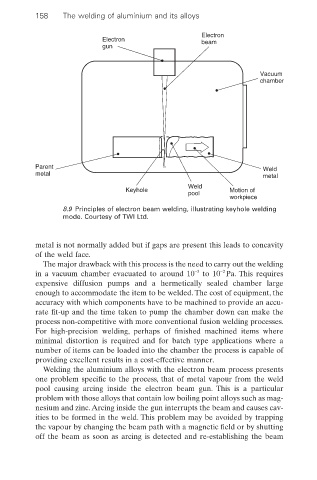
                     8.9 Principles of electron beam welding, illustrating keyhole welding
                     mode. Courtesy of TWI Ltd.


              metal is not normally added but if gaps are present this leads to concavity
              of the weld face.
                The major drawback with this process is the need to carry out the welding
                                                              -2
              in a vacuum chamber evacuated to around 10 -3  to 10 Pa. This requires
              expensive diffusion pumps and a hermetically sealed chamber large
              enough to accommodate the item to be welded. The cost of equipment, the
              accuracy with which components have to be machined to provide an accu-
              rate fit-up and the time taken to pump the chamber down can make the
              process non-competitive with more conventional fusion welding processes.
              For high-precision welding, perhaps of finished machined items where
              minimal distortion is required and for batch type applications  where a
              number of items can be loaded into the chamber the process is capable of
              providing excellent results in a cost-effective manner.
                Welding the aluminium alloys with the electron beam process presents
              one problem specific to the process, that of metal vapour from the weld
              pool causing arcing inside the electron beam gun. This is a particular
              problem with those alloys that contain low boiling point alloys such as mag-
              nesium and zinc.Arcing inside the gun interrupts the beam and causes cav-
              ities to be formed in the weld. This problem may be avoided by trapping
              the vapour by changing the beam path with a magnetic field or by shutting
              off the beam as soon as arcing is detected and re-establishing the beam

