


Page 1084 - The Mechatronics Handbook
P. 1084
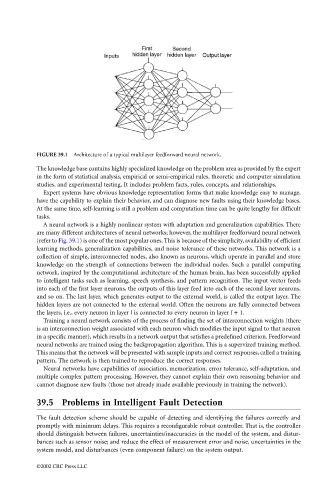
FIGURE 39.1  Architecture of a typical multilayer feedforward neural network.

                                 The knowledge base contains highly specialized knowledge on the problem area as provided by the expert
                                 in the form of statistical analysis, empirical or semi-empirical rules, theoretic and computer simulation
                                 studies, and experimental testing. It includes problem facts, rules, concepts, and relationships.
                                   Expert systems have obvious knowledge representation forms that make knowledge easy to manage,
                                 have the capability to explain their behavior, and can diagnose new faults using their knowledge bases.
                                 At the same time, self-learning is still a problem and computation time can be quite lengthy for difficult
                                 tasks.
                                   A neural network is a highly nonlinear system with adaptation and generalization capabilities. There
                                 are many different architectures of neural networks; however, the multilayer feedforward neural network
                                 (refer to Fig. 39.1) is one of the most popular ones. This is because of the simplicity, availability of efficient
                                 learning methods, generalization capabilities, and noise tolerance of these networks. This network is a
                                 collection of simple, interconnected nodes, also known as neurons, which operate in parallel and store
                                 knowledge on the strength of connections between the individual nodes. Such a parallel computing
                                 network, inspired by the computational architecture of the human brain, has been successfully applied
                                 to intelligent tasks such as learning, speech synthesis, and pattern recognition. The input vector feeds
                                 into each of the first layer neurons, the outputs of this layer feed into each of the second layer neurons,
                                 and so on. The last layer, which generates output to the external world, is called the output layer. The
                                 hidden layers are not connected to the external world. Often the neurons are fully connected between
                                 the layers, i.e., every neuron in layer l is connected to every neuron in layer l + 1.
                                   Training a neural network consists of the process of finding the set of interconnection weights (there
                                 is an interconnection weight associated with each neuron which modifies the input signal to that neuron
                                 in a specific manner), which results in a network output that satisfies a predefined criterion. Feedforward
                                 neural networks are trained using the backpropagation algorithm. This is a supervized training method.
                                 This means that the network will be presented with sample inputs and correct responses, called a training
                                 pattern. The network is then trained to reproduce the correct responses.
                                   Neural networks have capabilities of association, memorization, error tolerance, self-adaptation, and
                                 multiple complex pattern processing. However, they cannot explain their own reasoning behavior and
                                 cannot diagnose new faults (those not already made available previously in training the network).

                                 39.5 Problems in Intelligent Fault Detection

                                 The fault detection scheme should be capable of detecting and identifying the failures correctly and
                                 promptly with minimum delays. This requires a reconfigurable robust controller. That is, the controller
                                 should distinguish between failures, uncertainties/inaccuracies in the model of the system, and distur-
                                 bances such as sensor noise; and reduce the effect of measurement error and noise, uncertainties in the
                                 system model, and disturbances (even component failure) on the system output.

                                 ©2002 CRC Press LLC

