


Page 1086 - The Mechatronics Handbook
P. 1086
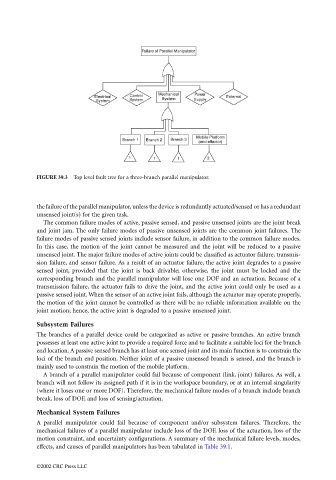
FIGURE 39.3  Top level fault tree for a three-branch parallel manipulator.


                                 the failure of the parallel manipulator, unless the device is redundantly actuated/sensed or has a redundant
                                 unsensed joint(s) for the given task.
                                   The common failure modes of active, passive sensed, and passive unsensed joints are the joint break
                                 and joint jam. The only failure modes of passive unsensed joints are the common joint failures. The
                                 failure modes of passive sensed joints include sensor failure, in addition to the common failure modes.
                                 In this case, the motion of the joint cannot be measured and the joint will be reduced to a passive
                                 unsensed joint. The major failure modes of active joints could be classified as actuator failure, transmis-
                                 sion failure, and sensor failure. As a result of an actuator failure, the active joint degrades to a passive
                                 sensed joint, provided that the joint is back drivable; otherwise, the joint must be locked and the
                                 corresponding branch and the parallel manipulator will lose one DOF and an actuation. Because of a
                                 transmission failure, the actuator fails to drive the joint, and the active joint could only be used as a
                                 passive sensed joint. When the sensor of an active joint fails, although the actuator may operate properly,
                                 the motion of the joint cannot be controlled as there will be no reliable information available on the
                                 joint motion; hence, the active joint is degraded to a passive unsensed joint.
                                 Subsystem Failures
                                 The branches of a parallel device could be categorized as active or passive branches. An active branch
                                 possesses at least one active joint to provide a required force and to facilitate a suitable loci for the branch
                                 end location. A passive sensed branch has at least one sensed joint and its main function is to constrain the
                                 loci of the branch end position. Neither joint of a passive unsensed branch is sensed, and the branch is
                                 mainly used to constrain the motion of the mobile platform.
                                   A branch of a parallel manipulator could fail because of component (link, joint) failures. As well, a
                                 branch will not follow its assigned path if it is in the workspace boundary, or at an internal singularity
                                 (where it loses one or more DOF). Therefore, the mechanical failure modes of a branch include branch
                                 break, loss of DOF, and loss of sensing/actuation.

                                 Mechanical System Failures
                                 A parallel manipulator could fail because of component and/or subsystem failures. Therefore, the
                                 mechanical failures of a parallel manipulator include loss of the DOF, loss of the actuation, loss of the
                                 motion constraint, and uncertainty configurations. A summary of the mechanical failure levels, modes,
                                 effects, and causes of parallel manipulators has been tabulated in Table 39.1.


                                 ©2002 CRC Press LLC

