


Page 547 - Bird R.B. Transport phenomena
P. 547
§17.3  Theory of Diffusion  in Gases at Low Density  527

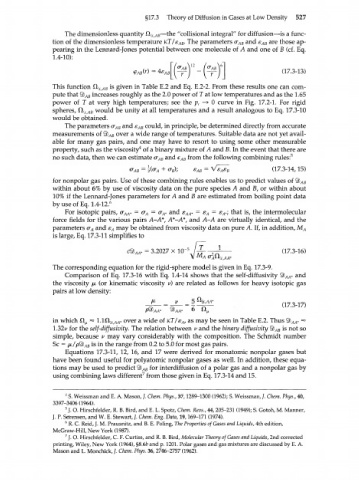
                    The  dimensionless  quantity  П  а лв —the "collisional  integral" for diffusion—is  a func-
                 tion of the dimensionless  temperature  KT/S .  The parameters a AB  and s AB  are those ap-
                                                     AB
                 pearing  in the Lennard-Jones potential between  one molecule  of A and  one of В (cf.  Eq.
                 1.4-10):
                                                                                    (17.3-13)

                 This  function  £lc l/AB is given  in Table  E.2 and Eq. E.2-2.  From  these  results  one can com-
                 pute  that  ЯЬ  increases  roughly as the 2.0 power  of Г at low temperatures and as the 1.65
                           АВ
                 power  of T at very  high  temperatures; see the p y  —> 0 curve  in Fig. 17.2-1. For rigid
                 spheres, П^  would  be unity at all temperatures and a result  analogous  to Eq.  17.3-10
                           /ЛВ
                 would be obtained.
                    The  parameters cr  and s AB  could, in principle, be determined directly  from  accurate
                                    AB
                 measurements of ЯЬ  over a wide  range  of temperatures. Suitable data are not yet avail-
                                  АВ
                 able  for many  gas pairs, and one may have  to resort  to using  some  other  measurable
                 property, such as the viscosity  of a binary mixture of A and B. In the event  that there are
                                          4
                 no  such data, then we can estimate a  and e  from  the following  combining  rules: 5
                                                      AB
                                                AB
                                        AB  I^PA  °*B)/   AB —  vs As B          (17.3-14,15)
                                       a   =     +       £
                 for  nonpolar  gas pairs. Use of these  combining  rules  enables  us to predict  values  of 3) ЛБ
                 within  about  6% by use of viscosity  data on the pure  species  A and B, or within  about
                 10% if the Lennard-Jones parameters for A and В are estimated  from  boiling  point data
                 by  use of Eq. 1.4-12. 6
                    For  isotopic  pairs,  cr *  = a A  = cr *  and  s *  = s A  = s *; that is, the  intermolecular
                                                        AA
                                                 A
                                      A4
                                                                   A
                 force  fields  for the various  pairs  A-A*,  A*-A*, and A-A are virtually  identical, and the
                 parameters a  and s A  may be obtained  from  viscosity  data on pure A. If, in addition, M A
                            A
                 is large, Eq. 17.3-11  simplifies to
                                       сЯЬ АА * = 3.2027  X 10" 5  / T 7 - - = - ^  (17.3-16)
                                                           M
                                                         V A  <г^ *
                                                                  и л
                 The  corresponding equation for the rigid-sphere  model is given  in Eq.  17.3-9.
                    Comparison  of Eq.  17.3-16 with  Eq.  1.4-14 shows  that the self-diffusivity  2) * and
                                                                                     дл
                 the  viscosity  /JL  (or kinematic  viscosity  v) are related  as follows  for heavy  isotopic gas
                 pairs at low density:
                                              M _    „  _  5 %АА*
                                                           П
                 in  which  11^ ~  l.lfty;,AA* over a wide  of кТ/е А/  as may be seen in Table  E.2. Thus  ЯЬ^* ~
                 1.32^  for the self-diffusivity.  The relation between  v and the binary diffusivity ЯЬ  is not so
                                                                                   АВ
                 simple,  because  v may vary  considerably  with  the composition.  The  Schmidt  number
                 Sc = \x/p4b  is in the range from  0.2 to 5.0 for most gas pairs.
                          AB
                    Equations  17.3-11,  12, 16, and 17 were  derived  for monatomic nonpolar gases but
                 have  been  found  useful  for polyatomic nonpolar gases as well. In addition, these  equa-
                 tions may be used  to predict %  for interdiffusion  of a polar gas and a nonpolar gas by
                                           AB
                 using  combining laws different 7  from  those given  in Eq. 17.3-14 and 15.

                    4  S. Weissman and E. A. Mason, /. Chem. Phys., 37,1289-1300 (1962);  S. Weissman, /. Chem. Phys., 40,
                 3397-3406  (1964).
                    5  J. O. Hirschfelder,  R. B. Bird, and E. L. Spotz,  Chem. Revs., 44, 205-231 (1949); S. Gotoh, M.  Manner,
                 J. P. Stfrensen,  and W. E. Stewart, /. Chem. Eng. Data, 19,169-171  (1974).
                    6  R. C. Reid, J. M. Prausnitz, and В. Е. Poling,  The Properties of Gases and Liquids, 4th edition,
                 McGraw-Hill,  New  York  (1987).
                    7  J. O. Hirschfelder,  C. F. Curtiss, and R. B. Bird, Molecular Theory of Gases and  Liquids, 2nd corrected
                 printing,  Wiley, New  York  (1964),  §8.6b and p. 1201.  Polar gases and gas mixtures  are discussed by E. A.
                 Mason and L. Monchick,  /. Chem. Phys. 36, 2746-2757  (1962).

