


Page 612 - Bird R.B. Transport phenomena
P. 612
592  Chapter 19  Equations  of Change for Multicomponent Systems


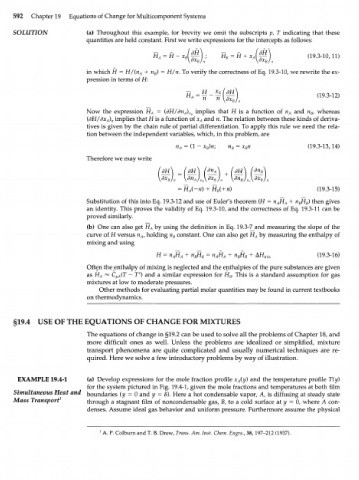
     SOLUTION              (a)  Throughout  this  example,  for  brevity  we  omit  the  subscripts  p,  T indicating  that  these
                           quantities are held constant. First we write expressions  for  the intercepts as  follows:

                                              H =H-    x (%f)  ;  H  = H + xl§f)            (19.3-10,11)
                                                A       B           B
                                                          х
                                                        \° в/п             \0Хв/п
                           in  which  H  = H/(n  + n )  = H/n.  To verify  the correctness  of  Eq. 19.3-10, we  rewrite  the ex-
                                          A    B
                           pression  in terms of Я:
                                                                   x
                                                        T3       _H l(dH
                                                        И
                                                         А  -  ТГ ~  ТГ I TZT I               (19.3-1
                                                                 n  b
                           Now  the  expression  H  =  (dH/dn ),  implies  that  Я  is  a  function  of  n  and  n ,  whereas
                                              A        A  h                           A     B
                           (дН/'дх )  implies that H is a function  of x A  and  n. The relation between  these kinds  of  deriva-
                                 А п
                           tives is given by  the chain rule  of  partial  differentiation.  To apply  this rule we  need  the rela-
                           tion between  the independent variables,  which, in this problem, are
                                                     n A  = (\-  x )n;  n B  = x n          (19.3-13,14)
                                                              B
                                                                         B
                           Therefore we may  write
                                                 дх )  \дп )„\дх )    \дп ) \дх в
                                                  в п
                                                                         в п
                                                          А
                                                               в п
                                                     =  Н (-п)  + Н (+п)                       (19.3-15)
                                                                 в
                                                         А
                           Substitution  of this into Eq. 19.3-12 and use  of  Euler's theorem (H = n H A  + n H ) then gives
                                                                                         B
                                                                                   A
                                                                                           B
                           an  identity. This proves  the validity  of  Eq.  19.3-10, and  the correctness  of  Eq.  19.3-11  can be
                           proved  similarly.
                           (b)  One can also  get  H  by  using  the definition  in  Eq. 19.3-7 and  measuring  the slope  of  the
                                             A
                           curve  of H versus n ,  holding  n  constant. One can also  get  H A  by  measuring  the enthalpy  of
                                                    B
                                          A
                           mixing and  using
                                               H  = n H  + n H  = n H  + щН  + AH             (19.3-16)
                                                    A  A  B  B  A  A     в     mi x
                           Often  the enthalpy  of  mixing  is neglected  and the enthalpies  of the pure substances  are given
                           as  H  ~  C {T  -  T°) and  a  similar  expression  for  H .  This  is  a standard  assumption  for  gas
                              A    pA                                B
                           mixtures at low  to moderate pressures.
                              Other methods for evaluating  partial molar quantities may be found  in current textbooks
                           on thermodynamics.
     §19.4  USE OF THE EQUATIONS         OF CHANGE FOR MIXTURES
                           The equations  of  change in  §19.2  can be used to solve all  the problems  of  Chapter  18,  and
                           more  difficult  ones  as  well.  Unless  the  problems  are  idealized  or  simplified,  mixture
                           transport  phenomena  are  quite  complicated  and  usually  numerical  techniques  are  re-
                           quired. Here we  solve a  few  introductory problems by  way  of  illustration.


      EXAMPLE 19.4-1       (a)  Develop  expressions  for  the mole  fraction  profile  x (y)  and  the temperature profile  T{y)
                                                                       A
                           for  the system  pictured  in Fig. 19.4-1, given the mole fractions  and temperatures at both  film
     Simultaneous  Heat  and  boundaries  (y  = 0 and  у  = 8). Here a hot condensable  vapor, A,  is  diffusing  at steady  state
     Mass Transport        through  a stagnant  film  of  noncondensable gas,  B, to a  cold  surface  at у  =  0, where  A  con-
                           denses.  Assume  ideal  gas  behavior  and  uniform  pressure.  Furthermore assume  the  physical


                               1  A. P. Colburn and T. B. Drew, Trans. Am. Inst. Chem. Engrs., 38,197-212 (1937).

