


Page 613 - Bird R.B. Transport phenomena
P. 613
§19.4  Use of the Equations  of Change for  Mixtures  593

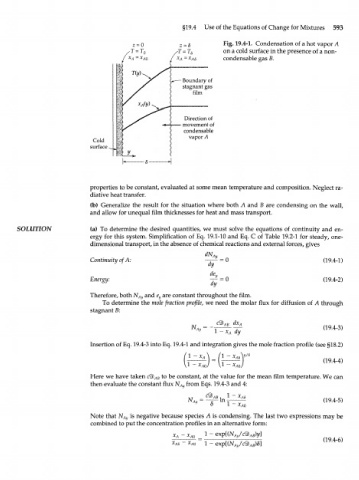
                                                                   Fig. 19.4-1.  Condensation  of a hot vapor  A
                                                                   on a cold surface  in the presence  of a non-
                                                     X   X         condensable  gas  B.
                                                      A  ~  A8
                                                   Г   stagnant gas
                                                       Boundary of
                                                          film


                                                       Direction of
                                                       movement of
                                                       condensable
                                                         vapor A
                             Cold
                            surface.


                            properties  to be constant, evaluated  at some mean temperature and  composition. Neglect  ra-
                            diative  heat  transfer.
                            (b)  Generalize  the  result  for  the  situation  where  both A  and  В are  condensing  on the wall,
                            and allow for unequal  film  thicknesses  for  heat and mass  transport.


      SOLUTION              (a)  To determine  the desired  quantities, we  must  solve the equations  of  continuity  and  en-
                            ergy  for  this  system.  Simplification  of  Eq.  19.1-10 and  Eq. С  of  Table  19.2-1  for  steady,  one-
                            dimensional  transport, in the absence  of chemical reactions and external  forces, gives
                                                             dN
                            Continuity  of A:                   Al  = 0                         (19.4-1)
                                                             ~dy

                            Energy:                                                             (19.4-2)

                            Therefore, both N Ay  and e  are constant throughout the  film.
                                                y
                               To determine the mole fraction profile,  we  need  the molar flux  for  diffusion  of  A  through
                            stagnant  B:

                                                                                                (19.4-3)
                                                           Av
                                                                l - x  A  dy
                            Insertion  of Eq. 19.4-3 into Eq. 19.4-1 and integration gives the mole fraction  profile  (see  §18.2)

                                                                    ~4 /5                       (19.4-4)
                            Here we  have  taken сЯЬ АВ  to be constant, at the value  for  the mean  film  temperature. We  can
                            then evaluate  the constant flux N  from  Eqs. 19.4-3 and 4:
                                                      Ay
                                                                    l-x
                                                                  In  A8                        (19.4-5)

                            Note that N Ay  is  negative  because  species  A  is  condensing.  The last  two  expressions  may  be
                            combined to put the concentration profiles  in an alternative  form:
                                                               ~  exp[(N /c® )y]
                                                      ~
                                                    X A  X A           Ay  AB                   (19.4-6)
                                                               -  exp[(N /c® )8]
                                                                           AB
                                                                       Ay

