


Page 224 - Understanding Automotive Electronics
P. 224
2735 | CH 6  Page 211  Tuesday, March 10, 1998  1:10 PM


                                         SENSORS AND ACTUATORS                                             6


                                         Desirable EGO Characteristics

                    An ideal EGO sensor       The EGO sensor characteristics that are desirable for the type of limit-
                    would have an abrupt,   cycle fuel control system that was discussed in Chapter 5 are as follows:
                    rapid, and significant   1. Abrupt change in voltage at stoichiometry
                    change in output voltage   2. Rapid switching of output voltage in response to exhaust gas oxygen
                    as the mixture passes     changes
                    through stoichiometry.   3. Large difference in sensor output voltage between rich and lean mixture
                    The output voltage        conditions
                    would not change as   4. Stable voltages with respect to exhaust temperature
                    exhaust gas temperature
                    changes.             Switching Characteristics
                    Hysteresis is the difference   The switching time for the EGO sensor also must be considered in control
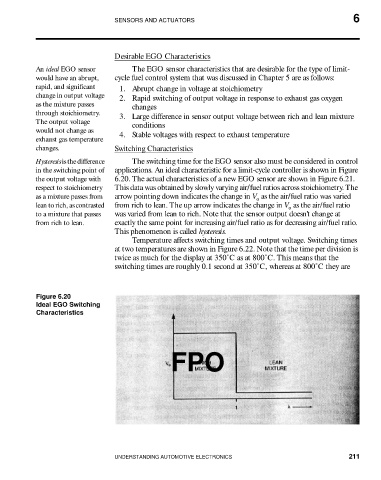
                    in the switching point of   applications. An ideal characteristic for a limit-cycle controller is shown in Figure
                    the output voltage with   6.20. The actual characteristics of a new EGO sensor are shown in Figure 6.21.
                    respect to stoichiometry   This data was obtained by slowly varying air/fuel ratios across stoichiometry. The
                    as a mixture passes from   arrow pointing down indicates the change in V  as the air/fuel ratio was varied
                                                                                o
                    lean to rich, as contrasted   from rich to lean. The up arrow indicates the change in V  as the air/fuel ratio
                                                                                         o
                    to a mixture that passes   was varied from lean to rich. Note that the sensor output doesn’t change at
                    from rich to lean.   exactly the same point for increasing air/fuel ratio as for decreasing air/fuel ratio.
                                         This phenomenon is called hysteresis.
                                              Temperature affects switching times and output voltage. Switching times
                                         at two temperatures are shown in Figure 6.22. Note that the time per division is
                                         twice as much for the display at 350˚C as at 800˚C. This means that the
                                         switching times are roughly 0.1 second at 350˚C, whereas at 800˚C they are


                    Figure 6.20
                    Ideal EGO Switching
                    Characteristics


                                                         FPO


                                         UNDERSTANDING AUTOMOTIVE ELECTRONICS                            211

