


Page 225 - Understanding Automotive Electronics
P. 225
2735 | CH 6  Page 212  Tuesday, March 10, 1998  1:10 PM


                6                     SENSORS AND ACTUATORS


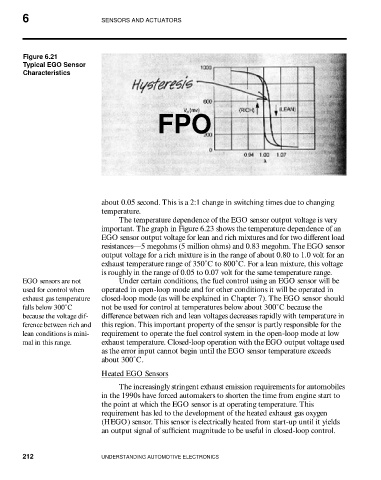
                Figure 6.21
                Typical EGO Sensor
                Characteristics


                                                     FPO


                                      about 0.05 second. This is a 2:1 change in switching times due to changing
                                      temperature.
                                          The temperature dependence of the EGO sensor output voltage is very
                                      important. The graph in Figure 6.23 shows the temperature dependence of an
                                      EGO sensor output voltage for lean and rich mixtures and for two different load
                                      resistances—5 megohms (5 million ohms) and 0.83 megohm. The EGO sensor
                                      output voltage for a rich mixture is in the range of about 0.80 to 1.0 volt for an
                                      exhaust temperature range of 350˚C to 800˚C. For a lean mixture, this voltage
                                      is roughly in the range of 0.05 to 0.07 volt for the same temperature range.
                EGO sensors are not       Under certain conditions, the fuel control using an EGO sensor will be
                used for control when   operated in open-loop mode and for other conditions it will be operated in
                exhaust gas temperature   closed-loop mode (as will be explained in Chapter 7). The EGO sensor should
                falls below 300˚C     not be used for control at temperatures below about 300˚C because the
                because the voltage dif-  difference between rich and lean voltages decreases rapidly with temperature in
                ference between rich and   this region. This important property of the sensor is partly responsible for the
                lean conditions is mini-  requirement to operate the fuel control system in the open-loop mode at low
                mal in this range.    exhaust temperature. Closed-loop operation with the EGO output voltage used
                                      as the error input cannot begin until the EGO sensor temperature exceeds
                                      about 300˚C.

                                      Heated EGO Sensors
                                          The increasingly stringent exhaust emission requirements for automobiles
                                      in the 1990s have forced automakers to shorten the time from engine start to
                                      the point at which the EGO sensor is at operating temperature. This
                                      requirement has led to the development of the heated exhaust gas oxygen
                                      (HEGO) sensor. This sensor is electrically heated from start-up until it yields
                                      an output signal of sufficient magnitude to be useful in closed-loop control.


                212                   UNDERSTANDING AUTOMOTIVE ELECTRONICS

