


Page 288 - Use Your Memory
P. 288
YOUR  MEMORY'S  RHYTHMS
                                          in which you are learning in such a way as to enable understanding
                                          to  remain  high  without  giving  the  memory  a  chance  to  sag  too
                                          deeply in the middle.  This  is  easily accomplished by learning to
                                          divide  your learning periods  into  the  most beneficial  time  units.
                                          These units, on the average, turn out to be between ten and sixty
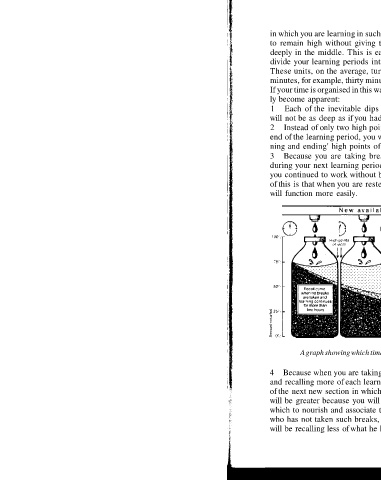
                                          minutes, for example, thirty minutes, as shown in the graph below.
                                          If your time is organised in this way, several advantages immediate-
                                          ly become apparent:
                                          1  Each  of the  inevitable  dips  in  your  memory  during learning
                                         will not be as deep as if you had  carried on without the break.
                                          2  Instead of only two high points of recall at the beginning and
                                          end of the learning period, you will have as many as eight 'begin-
                                          ning and ending'  high points  of recall.
                                          3  Because  you  are  taking  breaks,  you  will  be  far  more  rested
                                          during your  next learning period  than you would  have been had
                                         you continued to work without breaks. The additional  advantage
                                          of this is that when you are rested, both recall and understanding
                                         will  function more  easily.


                                              A graph showing which time units give maximum recall
                                          4  Because when you are taking breaks you are both more rested
                                          and recalling more of each learning session, your comprehension
                                          of the  next new section  in which you find yourself after the break
                                         will be  greater because  you  will  have  laid  a  firmer  foundation in
                                         which to nourish and associate the  new information. The person
                                         who has not taken such breaks,  in addition to a growing fatigue,
                                         will be recalling less of what he has learned before, and therefore
                                                                          167

