


Page 448 - Materials Chemistry, Second Edition
P. 448
CAT3525_C12.qxd  1/27/2005  4:11 PM  Page 419
                       Hazardous Waste Generator Requirements                                      419


                                                                                FIGURE A.12.3  Drum with
                                                                                questionable dates on label.


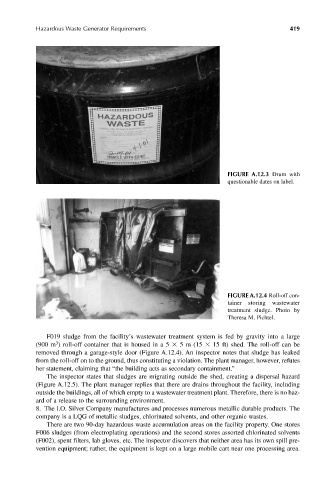
                                                                                FIGURE A.12.4 Roll-off con-
                                                                                tainer storing wastewater
                                                                                treatment sludge. Photo by
                                                                                Theresa M. Pichtel.

                          F019 sludge from the facility’s wastewater treatment system is fed by gravity into a large
                             3
                       (900 m ) roll-off container that is housed in a 5   5 m (15   15 ft) shed. The roll-off can be
                       removed through a garage-style door (Figure A.12.4). An inspector notes that sludge has leaked
                       from the roll-off on to the ground, thus constituting a violation. The plant manager, however, refutes
                       her statement, claiming that “the building acts as secondary containment.”
                          The inspector states that sludges are migrating outside the shed, creating a dispersal hazard
                       (Figure A.12.5). The plant manager replies that there are drains throughout the facility, including
                       outside the buildings, all of which empty to a wastewater treatment plant. Therefore, there is no haz-
                       ard of a release to the surrounding environment.
                       8. The I.O. Silver Company manufactures and processes numerous metallic durable products. The
                       company is a LQG of metallic sludges, chlorinated solvents, and other organic wastes.
                          There are two 90-day hazardous waste accumulation areas on the facility property. One stores
                       F006 sludges (from electroplating operations) and the second stores assorted chlorinated solvents
                       (F002), spent filters, lab gloves, etc. The inspector discovers that neither area has its own spill pre-
                       vention equipment; rather, the equipment is kept on a large mobile cart near one processing area.

