


Page 260 - Wastewater Solids Incineration Systems
P. 260
222         Wastewater Solids Incineration Systems


                        • Excess air reduction,
                        • Combustion control,

                        • Draft control, and
                        • Air pollution control.


                    2.4 Autogenous versus Nonautogenous Operations
                    Depending on the site-specific percent total solids, percent volatile solids, and heat
                    content of the cake solids, an MHF may operate either autogenously or nonautoge-
                    nously. There are several factors to take into account when calculating the autoge-
                    nous condition: incinerator exhaust gas temperature, amount of excess combustion
                    air, and temperature of combustion air introduced to the incinerator.
                    2.4.1 Autogenous Operation
                    Autogenous incineration maintains stable combustion without use of auxiliary fuels.
                    The operator calculates the percent dry solids in the feed cake at which autogenous
                    combustion can occur.
                        Autogenous combustion typically occurs when the heat released by combustion
                    of the solids is equal to the heat required to evaporate the water in the feed cake. For
                    detailed calculations, see Chapter 4, Combustion Theory. A rapid calculation can be
                    made using the following formula:
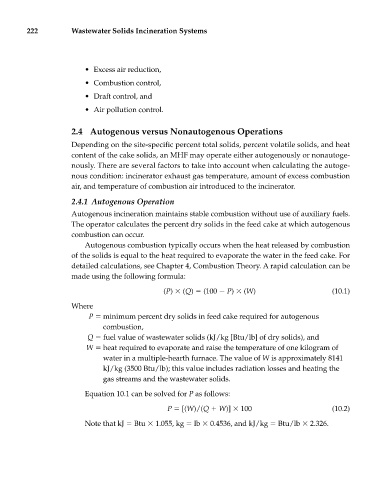
                                             (P)   (Q)   (100   P)   (W)                  (10.1)

                    Where
                         P   minimum percent dry solids in feed cake required for autogenous
                             combustion,
                         Q   fuel value of wastewater solids (kJ/kg [Btu/lb] of dry solids), and
                        W   heat required to evaporate and raise the temperature of one kilogram of
                             water in a multiple-hearth furnace. The value of W is approximately 8141
                             kJ/kg (3500 Btu/lb); this value includes radiation losses and heating the
                             gas streams and the wastewater solids.

                        Equation 10.1 can be solved for P as follows:
                                              P   [(W)/(Q   W)]   100                     (10.2)

                        Note that kJ   Btu   1.055, kg   lb   0.4536, and kJ/kg   Btu/lb   2.326.

