


Page 322 - Water Loss Control
P. 322
Contr olling Real Losses in the Field—Pr oactive Leak Detection     291


                           include in the night flow analysis. Household night water use can be determined
                           by gathering data through manual or fixed network automatic meter readings
                           during the minimum nighttime consumption period, or through deployment of
                           data-loggers recording the household night use.  Alternatively, data from the
                           literature can be used, for example, the U.K. Managing Leakage Series provides
                           details of assessed night use studies in the U.K. between 1991 and 1993 and the
                           AWWA Research Foundation project residential end uses of water (REUWS)
                           provides data on North  American night use volumes. If there is significant
                           nighttime landscape irrigation consumption at certain times during the year, it is
                           recommended to undertake DMA MNF analysis during periods of no irrigation
                           or when irrigation is at a minimum, usually during the winter period.


                    16.6.7  Prioritizing DMA Leak Detection Efforts
                    DMAs allow assessment of leakage volumes in a hydraulically discrete zone. If multiple
                    DMAs are established in the service area, leakage volumes can be assessed for each of
                    the DMAs on a regular basis. The results gained from the DMA measurements allow a utility
                    to prioritize its leak detection efforts, targeting the DMA(s) with the highest leakage volume,
                    where the leak detection efforts bring the best results in real loss reduction in relation to the
                    work effort required. Consequentially, targets can be set to decide which DMA needs to be
                    addressed and in what order by the leak detection team. A simple starting point for pri-
                    oritization of leak detection efforts is to rank DMAs according to their volume of real losses
                    per service connection. This applies to utilities in urban areas, while rural utilities should con-
                    sider expressing the volume of real losses by length of main. The use of DMAs results in a
                    strategic scheduling of leak detection crew activities. This is more efficient that the historic
                    practice of crews canvassing portions of the service area based upon fixed time intervals.
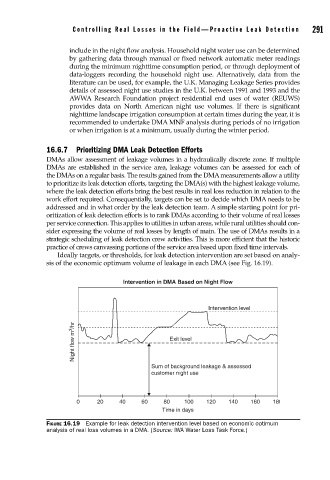
                       Ideally targets, or thresholds, for leak detection intervention are set based on analy-
                    sis of the economic optimum volume of leakage in each DMA (see Fig. 16.19).


                                          Intervention in DMA Based on Night Flow


                                                                   Intervention level

                            Night flow m 3 /hr         Exit level


                                                  Sum of background leakage & assessed
                                                  customer night use


                             0     20    40    60     80    100   120   140    160   180
                                                     Time in days
                    FIGURE 16.19  Example for leak detection intervention level based on economic optimum
                    analysis of real loss volumes in a DMA. (Source: IWA Water Loss Task Force.)

