


Page 334 - Water Loss Control
P. 334
Contr olling Real Losses—Pr essur e Management      303


                    a pressure management scheme. When considering reduction of leakage practitioners
                    usually think of pressure reducing functions, however, in many cases, in particularly
                    pumped systems, leakage can be reduced greatly by surge anticipation.

                    Water Conservation
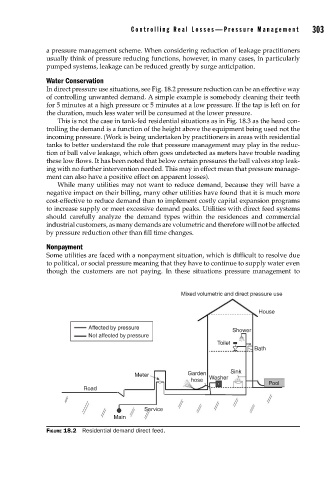
                    In direct pressure use situations, see Fig. 18.2 pressure reduction can be an effective way
                    of controlling unwanted demand. A simple example is somebody cleaning their teeth
                    for 5 minutes at a high pressure or 5 minutes at a low pressure. If the tap is left on for
                    the duration, much less water will be consumed at the lower pressure.
                       This is not the case in tank-fed residential situations as in Fig. 18.3 as the head con-
                    trolling the demand is a function of the height above the equipment being used not the
                    incoming pressure. (Work is being undertaken by practitioners in areas with residential
                    tanks to better understand the role that pressure management may play in the reduc-
                    tion of ball valve leakage, which often goes undetected as meters have trouble reading
                    these low flows. It has been noted that below certain pressures the ball valves stop leak-
                    ing with no further intervention needed. This may in effect mean that pressure manage-
                    ment can also have a positive effect on apparent losses).
                       While many utilities may not want to reduce demand, because they will have a
                    negative impact on their billing, many other utilities have found that it is much more
                    cost-effective to reduce demand than to implement costly capital expansion programs
                    to increase supply or meet excessive demand peaks. Utilities with direct feed systems
                    should carefully analyze the demand types within the residences and commercial
                    industrial customers, as many demands are volumetric and therefore will not be affected
                    by pressure reduction other than fill time changes.
                    Nonpayment
                    Some utilities are faced with a nonpayment situation, which is difficult to resolve due
                    to political, or social pressure meaning that they have to continue to supply water even
                    though the customers are not paying. In these situations pressure management to


                                                           Mixed volumetric and direct pressure use

                                                                                 House

                                Affected by pressure
                                                                         Shower
                                Not affected by pressure
                                                                     Toilet
                                                                                Bath


                                             Meter           Garden      Sink
                                                              hose  Washer
                                                                                    Pool
                               Road

                                                Service
                                       Main
                    FIGURE 18.2  Residential demand direct feed.

