


Page 150 - Encyclopedia of the Unusual and Unexplained Vol. 3
P. 150
Mysteries of the Mind                                                                         131

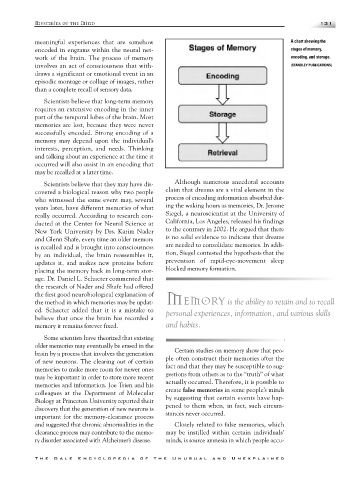
             meaningful experiences that are somehow                                             A chart showing the
             encoded in engrams within the neural net-                                           stages of memory,
             work of the brain. The process of memory                                            encoding, and storage.
             involves an act of consciousness that with-                                         (STANDLEY PUBLICATIONS)
             draws a significant or emotional event in an
             episodic montage or collage of images, rather
             than a complete recall of sensory data.
                Scientists believe that long-term memory
             requires an extensive encoding in the inner
             part of the temporal lobes of the brain. Most
             memories are lost, because they were never
             successfully encoded. Strong encoding of a
             memory may depend upon the individual’s
             interests, perception, and needs. Thinking
             and talking about an experience at the time it
             occurred will also assist in an encoding that
             may be recalled at a later time.
                Scientists believe that they may have dis-  Although numerous anecdotal accounts
             covered a biological reason why two people  claim that dreams are a vital element in the
             who witnessed the same event may, several  process of encoding information absorbed dur-
             years later, have different memories of what  ing the waking hours as memories, Dr. Jerome
             really occurred. According to research con-  Siegel, a neuroscientist at the University of
             ducted at the Center for Neural Science at  California, Los Angeles, released his findings
             New York University by Drs. Karim Nader    to the contrary in 2002. He argued that there
             and Glenn Shafe, every time an older memory  is no solid evidence to indicate that dreams
             is recalled and is brought into consciousness  are needed to consolidate memories. In addi-
             by an individual, the brain reassembles it,  tion, Siegel contested the hypothesis that the
             updates it, and makes new proteins before  prevention of rapid-eye-movement sleep
             placing the memory back in long-term stor-  blocked memory formation.
             age. Dr. Daniel L. Schacter commented that
             the research of Nader and Shafe had offered
             the first good neurobiological explanation of
             the method in which memories may be updat- MEMORY is the ability to retain and to recall
             ed. Schacter added that it is a mistake to  personal experiences, information, and various skills
             believe that once the brain has recorded a
             memory it remains forever fixed.           and habits.
                Some scientists have theorized that existing
             older memories may eventually be erased in the
             brain by a process that involves the generation  Certain studies on memory show that peo-
             of new neurons. The clearing out of certain  ple often construct their memories after the
             memories to make more room for newer ones  fact and that they may be susceptible to sug-
             may be important in order to store more recent  gestions from others as to the “truth” of what
             memories and information. Joe Tsien and his  actually occurred. Therefore, it is possible to
             colleagues at the Department of Molecular  create false memories in some people’s minds
             Biology at Princeton University reported their  by suggesting that certain events have hap-
             discovery that the generation of new neurons is  pened to them when, in fact, such circum-
             important for the memory-clearance process  stances never occurred.
             and suggested that chronic abnormalities in the  Closely related to false memories, which
             clearance process may contribute to the memo-  may be instilled within certain individuals’
             ry disorder associated with Alzheimer’s disease.  minds, is source amnesia in which people accu-


             The Gale Enc y clopedia of the Unusu al and Unexplained

