


Page 147 - Encyclopedia of the Unusual and Unexplained Vol. 3
P. 147
128                                                                           Mysteries of the Mind

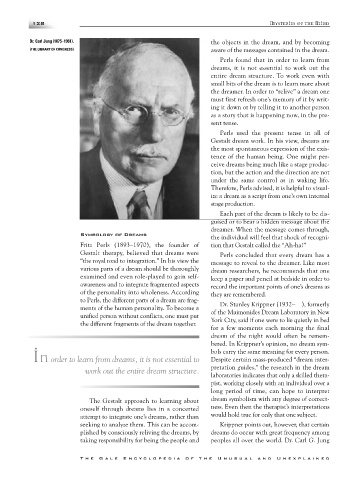
           Dr. Carl Jung (1875–1961).                                  the objects in the dream, and by becoming
           (THE LIBRARY OF CONGRESS)                                   aware of the messages contained in the dream.
                                                                          Perls found that in order to learn from
                                                                       dreams, it is not essential to work out the
                                                                       entire dream structure. To work even with
                                                                       small bits of the dream is to learn more about
                                                                       the dreamer. In order to “relive” a dream one
                                                                       must first refresh one’s memory of it by writ-
                                                                       ing it down or by telling it to another person
                                                                       as a story that is happening now, in the pre-
                                                                       sent tense.
                                                                          Perls used the present tense in all of
                                                                       Gestalt dream work. In his view, dreams are
                                                                       the most spontaneous expression of the exis-
                                                                       tence of the human being. One might per-
                                                                       ceive dreams being much like a stage produc-
                                                                       tion, but the action and the direction are not
                                                                       under the same control as in waking life.
                                                                       Therefore, Perls advised, it is helpful to visual-
                                                                       ize a dream as a script from one’s own internal
                                                                       stage production.
                                                                          Each part of the dream is likely to be dis-
                                                                       guised or to bear a hidden message about the
                                                                       dreamer. When the message comes through,
                            Symbology of Dreams
                                                                       the individual will feel that shock of recogni-
                            Fritz Perls (1893–1970), the founder of    tion that Gestalt called the “Ah-ha!”
                            Gestalt therapy, believed that dreams were    Perls concluded that every dream has a
                            “the royal road to integration.” In his view the  message to reveal to the dreamer. Like most
                            various parts of a dream should be thoroughly  dream researchers, he recommends that one
                            examined and even role-played to gain self-  keep a paper and pencil at bedside in order to
                            awareness and to integrate fragmented aspects  record the important points of one’s dreams as
                            of the personality into wholeness. According  they are remembered.
                            to Perls, the different parts of a dream are frag-
                                                                          Dr. Stanley Krippner (1932–    ), formerly
                            ments of the human personality. To become a
                                                                       of the Maimonides Dream Laboratory in New
                            unified person without conflicts, one must put
                                                                       York City, said if one were to lie quietly in bed
                            the different fragments of the dream together.
                                                                       for a few moments each morning the final
                                                                       dream of the night would often be remem-
                                                                       bered. In Krippner’s opinion, no dream sym-
                                                                       bols carry the same meaning for every person.
            IN order to learn from dreams, it is not essential to      Despite certain mass-produced “dream inter-
                                                                       pretation guides,” the research in the dream
                             work out the entire dream structure.
                                                                       laboratories indicates that only a skilled thera-
                                                                       pist, working closely with an individual over a
                                                                       long period of time, can hope to interpret
                               The Gestalt approach to learning about  dream symbolism with any degree of correct-
                            oneself through dreams lies in a concerted  ness. Even then the therapist’s interpretations
                            attempt to integrate one’s dreams, rather than  would hold true for only that one subject.
                            seeking to analyze them. This can be accom-   Krippner points out, however, that certain
                            plished by consciously reliving the dreams, by  dreams do occur with great frequency among
                            taking responsibility for being the people and  peoples all over the world. Dr. Carl G. Jung


                            The Gale Enc y clopedia of the Unusu al and Unexplained

