


Page 180 - Encyclopedia of the Unusual and Unexplained Vol. 3
P. 180
Mysteries of the Mind                                                                         161


             ESP Researchers

                n their biennial report on the state of sci-
                ence understanding released in April
             I2002, the National Science Foundation
             found that 60 percent of adults in the United
             States agreed or strongly agreed that some
             people possess psychic powers or extrasensory
             perception (ESP). In June 2002, the Con-
             sumer Analysis Group conducted the most
             extensive survey ever done in the United
             Kingdom and revealed that 67 percent of
             adults believed in psychic powers. Report
             author Jan Walsh, commenting on the statis-
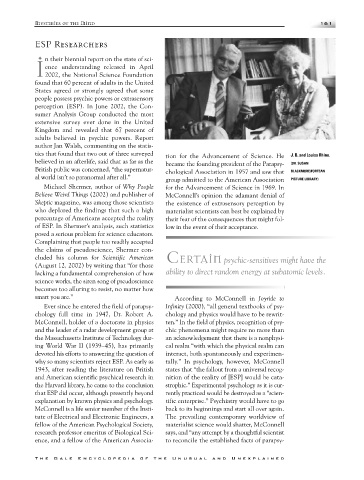
             tics that found that two out of three surveyed  tion for the Advancement of Science. He  J. B. and Louisa Rhine.
             believed in an afterlife, said that as far as the  became the founding president of the Parapsy-  (DR. SUSAN
             British public was concerned, “the supernatur-  chological Association in 1957 and saw that  BLACKMORE/FORTEAN
             al world isn’t so paranormal after all.”   group admitted to the American Association  PICTURE LIBRARY)
                Michael Shermer, author of Why People   for the Advancement of Science in 1969. In
             Believe Weird Things (2002) and publisher of  McConnell’s opinion the adamant denial of
             Skeptic magazine, was among those scientists  the existence of extrasensory perception by
             who deplored the findings that such a high  materialist scientists can best be explained by
             percentage of Americans accepted the reality  their fear of the consequences that might fol-
             of ESP. In Shermer’s analysis, such statistics  low in the event of their acceptance.
             posed a serious problem for science educators.
             Complaining that people too readily accepted
             the claims of pseudoscience, Shermer con-
             cluded his column for  Scientific American  CERTAIN psychic-sensitives might have the
             (August 12, 2002) by writing that “for those
             lacking a fundamental comprehension of how  ability to direct random energy at subatomic levels.
             science works, the siren song of pseudoscience
             becomes too alluring to resist, no matter how
             smart you are.”                               According to McConnell in  Joyride to
                Ever since he entered the field of parapsy-  Infinity (2000), “all general textbooks of psy-
             chology full time in 1947, Dr. Robert A.   chology and physics would have to be rewrit-
             McConnell, holder of a doctorate in physics  ten.” In the field of physics, recognition of psy-
             and the leader of a radar development group at  chic phenomena might require no more than
             the Massachusetts Institute of Technology dur-  an acknowledgement that there is a nonphysi-
             ing World War II (1939–45), has primarily  cal realm “with which the physical realm can
             devoted his efforts to answering the question of  interact, both spontaneously and experimen-
             why so many scientists reject ESP. As early as  tally.” In psychology, however, McConnell
             1943, after reading the literature on British  states that “the fallout from a universal recog-
             and American scientific psychical research in  nition of the reality of [ESP] would be cata-
             the Harvard library, he came to the conclusion  strophic.” Experimental psychology as it is cur-
             that ESP did occur, although presently beyond  rently practiced would be destroyed as a “scien-
             explanation by known physics and psychology.  tific enterprise.” Psychiatry would have to go
             McConnell is a life senior member of the Insti-  back to its beginnings and start all over again.
             tute of Electrical and Electronic Engineers, a  The prevailing contemporary worldview of
             fellow of the American Psychological Society,  materialist science would shatter, McConnell
             research professor emeritus of Biological Sci-  says, and “any attempt by a thoughtful scientist
             ence, and a fellow of the American Associa-  to reconcile the established facts of parapsy-


             The Gale Enc y clopedia of the Unusu al and Unexplained

