


Page 181 - Encyclopedia of the Unusual and Unexplained Vol. 3
P. 181
162                                                                           Mysteries of the Mind

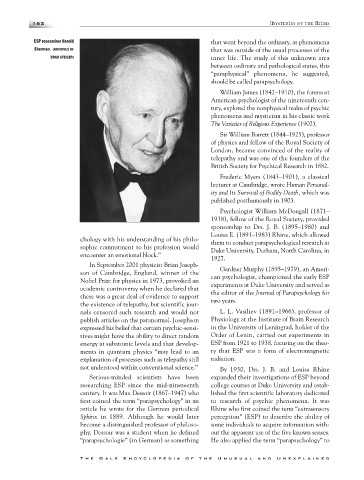
            ESP researcher Harold                                      that went beyond the ordinary, as phenomena
            Sherman. (ARCHIVES OF                                      that was outside of the usual processes of the
                  BRAD STEIGER)                                        inner life. The study of this unknown area
                                                                       between ordinary and pathological states, this
                                                                       “paraphysical” phenomena, he suggested,
                                                                       should be called parapsychology.
                                                                          William James (1842–1910), the foremost
                                                                       American psychologist of the nineteenth cen-
                                                                       tury, explored the nonphysical realm of psychic
                                                                       phenomena and mysticism in his classic work
                                                                       The Varieties of Religious Experience (1902).
                                                                          Sir William Barrett (1844–1925), professor
                                                                       of physics and fellow of the Royal Society of
                                                                       London, became convinced of the reality of
                                                                       telepathy and was one of the founders of the
                                                                       British Society for Psychical Research in 1882.
                                                                          Frederic Myers (1843–1901), a classical
                                                                       lecturer at Cambridge, wrote Human Personal-
                                                                       ity and Its Survival of Bodily Death, which was
                                                                       published posthumously in 1903.
                                                                          Psychologist William McDougall (1871–
                                                                       1938), fellow of the Royal Society, provided
                                                                       sponsorship to Drs. J. B. (1895–1980) and
                                                                       Louisa E. (1891–1983) Rhine, which allowed
                            chology with his understanding of his philo-  them to conduct parapsychological research at
                            sophic commitment to his profession would  Duke University, Durham, North Carolina, in
                            encounter an emotional block.”
                                                                       1927.
                               In September 2001 physicist Brian Joseph-
                                                                          Gardner Murphy (1895–1979), an Ameri-
                            son of Cambridge, England, winner of the
                                                                       can psychologist, championed the early ESP
                            Nobel Prize for physics in 1973, provoked an
                                                                       experiments at Duke University and served as
                            academic controversy when he declared that
                                                                       the editor of the Journal of Parapsychology for
                            there was a great deal of evidence to support
                                                                       two years.
                            the existence of telepathy, but scientific jour-
                            nals censored such research and would not     L. L. Vasiliev (1891–1966), professor of
                            publish articles on the paranormal. Josephson  Physiology at the Institute of Brain Research
                            expressed his belief that certain psychic-sensi-  in the University of Leningrad, holder of the
                            tives might have the ability to direct random  Order of Lenin, carried out experiments in
                            energy at subatomic levels and that develop-  ESP from 1921 to 1938, focusing on the theo-
                            ments in quantum physics “may lead to an   ry that ESP was a form of electromagnetic
                            explanation of processes such as telepathy still  radiation.
                            not understood within conventional science.”  By 1930, Drs. J. B. and Louisa Rhine
                               Serious-minded scientists have been     expanded their investigations of ESP beyond
                            researching ESP since the mid-nineteenth   college courses at Duke University and estab-
                            century. It was Max Dessoir (1867–1947) who  lished the first scientific laboratory dedicated
                            first coined the term “parapsychology” in an  to research of psychic phenomena. It was
                            article he wrote for the German periodical  Rhine who first coined the term “extrasensory
                            Sphinx in 1889. Although he would later    perception” (ESP) to describe the ability of
                            become a distinguished professor of philoso-  some individuals to acquire information with-
                            phy, Dessoir was a student when he defined  out the apparent use of the five known senses.
                            “parapsychologie” (in German) as something  He also applied the term “parapsychology” to


                            The Gale Enc y clopedia of the Unusu al and Unexplained

