


Page 182 - Encyclopedia of the Unusual and Unexplained Vol. 3
P. 182
Mysteries of the Mind                                                                         163

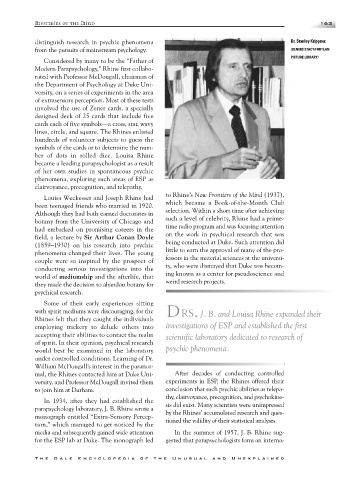
             distinguish research in psychic phenomena                                           Dr. Stanley Krippner.
             from the pursuits of mainstream psychology.                                         (DENNIS STACY/FORTEAN
                                                                                                 PICTURE LIBRARY)
                Considered by many to be the “Father of
             Modern Parapsychology,” Rhine first collabo-
             rated with Professor McDougall, chairman of
             the Department of Psychology at Duke Uni-
             versity, on a series of experiments in the area
             of extrasensory perception. Most of these tests
             involved the use of Zener cards, a specially
             designed deck of 25 cards that include five
             cards each of five symbols—a cross, star, wavy
             lines, circle, and square. The Rhines enlisted
             hundreds of volunteer subjects to guess the
             symbols of the cards or to determine the num-
             ber of dots in rolled dice. Louisa Rhine
             became a leading parapsychologist as a result
             of her own studies in spontaneous psychic
             phenomena, exploring such areas of ESP as
             clairvoyance, precognition, and telepathy.
                                                        to Rhine’s New Frontiers of the Mind (1937),
                Louisa Weckesser and Joseph Rhine had
             been teenaged friends who married in 1920.  which became a Book-of-the-Month Club
             Although they had both earned doctorates in  selection. Within a short time after achieving
             botany from the University of Chicago and  such a level of celebrity, Rhine had a prime-
             had embarked on promising careers in the   time radio program and was focusing attention
             field, a lecture by Sir Arthur Conan Doyle  on the work in psychical research that was
             (1859–1930) on his research into psychic   being conducted at Duke. Such attention did
             phenomena changed their lives. The young   little to earn the approval of many of the pro-
             couple were so inspired by the prospect of  fessors in the material sciences at the universi-
             conducting serious investigations into the  ty, who were dismayed that Duke was becom-
             world of mediumship and the afterlife, that  ing known as a center for pseudoscience and
             they made the decision to abandon botany for  weird research projects.
             psychical research.
                Some of their early experiences sitting
             with spirit mediums were discouraging, for the  DRS. J. B. and Louisa Rhine expanded their
             Rhines felt that they caught the individuals
             employing trickery to delude others into   investigations of ESP and established the first
             accepting their abilities to contact the realm  scientific laboratory dedicated to research of
             of spirit. In their opinion, psychical research
             would best be examined in the laboratory   psychic phenomena.
             under controlled conditions. Learning of Dr.
             William McDougall’s interest in the paranor-
             mal, the Rhines contacted him at Duke Uni-    After decades of conducting controlled
             versity, and Professor McDougall invited them  experiments in ESP, the Rhines offered their
             to join him at Durham.                     conclusion that such psychic abilities as telepa-
                                                        thy, clairvoyance, precognition, and psychokine-
                In 1934, after they had established the
                                                        sis did exist. Many scientists were unimpressed
             parapsychology laboratory, J. B. Rhine wrote a
                                                        by the Rhines’ accumulated research and ques-
             monograph entitled “Extra-Sensory Percep-
                                                        tioned the validity of their statistical analyses.
             tion,” which managed to get noticed by the
             media and subsequently gained wide attention  In the summer of 1957, J. B. Rhine sug-
             for the ESP lab at Duke. The monograph led  gested that parapsychologists form an interna-


             The Gale Enc y clopedia of the Unusu al and Unexplained

