


Page 358 - Accounting Information Systems
P. 358
C H A P TER 7      The Conversion Cycle  329


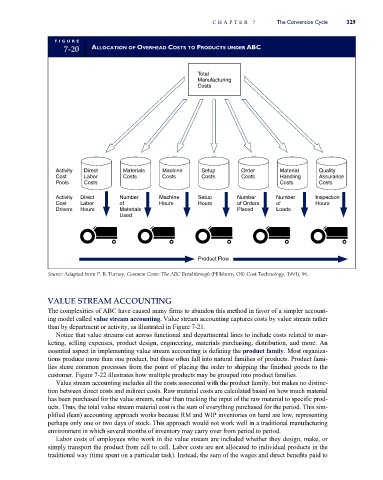
                         FI G U R E
                           7-20     ALLOCATION OF OVERHEAD COSTS TO PRODUCTS UNDER ABC


                                                                    Total
                                                                    Manufacturing
                                                                    Costs


                         Activity  Direct    Materials   Machine     Setup       Order      Material    Quality
                         Cost    Labor       Costs                        Costs  Costs      Handling    Assurance
                                                         Costs
                         Pools   Costs                                                      Costs       Costs
                         Activity  Direct   Number      Machine     Setup      Number      Number      Inspection
                         Cost   Labor       of          Hours       Hours      of Orders   of          Hours
                         Drivers  Hours     Materials                          Placed      Loads
                                            Used


                                                                    Product Flow

                       Source: Adapted from P. B. Turney, Common Cents: The ABC Breakthrough (Hillsboro, OR: Cost Technology, 1991), 96.


                       VALUE STREAM ACCOUNTING
                       The complexities of ABC have caused many firms to abandon this method in favor of a simpler account-
                       ing model called value stream accounting. Value stream accounting captures costs by value stream rather
                       than by department or activity, as illustrated in Figure 7-21.
                         Notice that value streams cut across functional and departmental lines to include costs related to mar-
                       keting, selling expenses, product design, engineering, materials purchasing, distribution, and more. An
                       essential aspect in implementing value stream accounting is defining the product family. Most organiza-
                       tions produce more than one product, but these often fall into natural families of products. Product fami-
                       lies share common processes from the point of placing the order to shipping the finished goods to the
                       customer. Figure 7-22 illustrates how multiple products may be grouped into product families.
                         Value stream accounting includes all the costs associated with the product family, but makes no distinc-
                       tion between direct costs and indirect costs. Raw material costs are calculated based on how much material
                       has been purchased for the value stream, rather than tracking the input of the raw material to specific prod-
                       ucts. Thus, the total value stream material cost is the sum of everything purchased for the period. This sim-
                       plified (lean) accounting approach works because RM and WIP inventories on hand are low, representing
                       perhaps only one or two days of stock. This approach would not work well in a traditional manufacturing
                       environment in which several months of inventory may carry over from period to period.
                         Labor costs of employees who work in the value stream are included whether they design, make, or
                       simply transport the product from cell to cell. Labor costs are not allocated to individual products in the
                       traditional way (time spent on a particular task). Instead, the sum of the wages and direct benefits paid to

