


Page 356 - Accounting Information Systems
P. 356
C H A P TER 7      The Conversion Cycle  327


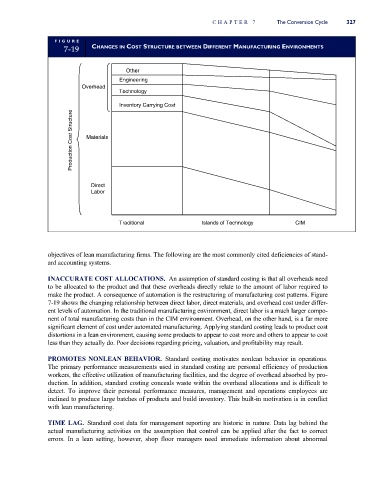
                         FI G U R E
                           7-19     CHANGES IN COST STRUCTURE BETWEEN DIFFERENT MANUFACTURING ENVIRONMENTS


                                              Other
                                            Engineering
                                 Overhead
                                            Technology

                                            Inventory Carrying Cost
                              Production Cost Structure  Materials


                                    Direct
                                    Labor


                                            Traditional              Islands of Technology       CIM


                       objectives of lean manufacturing firms. The following are the most commonly cited deficiencies of stand-
                       ard accounting systems.

                       INACCURATE COST ALLOCATIONS. An assumption of standard costing is that all overheads need
                       to be allocated to the product and that these overheads directly relate to the amount of labor required to
                       make the product. A consequence of automation is the restructuring of manufacturing cost patterns. Figure
                       7-19 shows the changing relationship between direct labor, direct materials, and overhead cost under differ-
                       ent levels of automation. In the traditional manufacturing environment, direct labor is a much larger compo-
                       nent of total manufacturing costs than in the CIM environment. Overhead, on the other hand, is a far more
                       significant element of cost under automated manufacturing. Applying standard costing leads to product cost
                       distortions in a lean environment, causing some products to appear to cost more and others to appear to cost
                       less than they actually do. Poor decisions regarding pricing, valuation, and profitability may result.

                       PROMOTES NONLEAN BEHAVIOR. Standard costing motivates nonlean behavior in operations.
                       The primary performance measurements used in standard costing are personal efficiency of production
                       workers, the effective utilization of manufacturing facilities, and the degree of overhead absorbed by pro-
                       duction. In addition, standard costing conceals waste within the overhead allocations and is difficult to
                       detect. To improve their personal performance measures, management and operations employees are
                       inclined to produce large batches of products and build inventory. This built-in motivation is in conflict
                       with lean manufacturing.

                       TIME LAG. Standard cost data for management reporting are historic in nature. Data lag behind the
                       actual manufacturing activities on the assumption that control can be applied after the fact to correct
                       errors. In a lean setting, however, shop floor managers need immediate information about abnormal

