


Page 351 - Accounting Information Systems
P. 351
322     PART II       Transaction Cycles and Business Processes

                         Lean requires a constant state of quality control along with the authority to take immediate action. When
                         Toyota first introduced TPS, its production employees had the authority to shut down the line when
                         defects were discovered. In the early days, the line was often shut down to bring attention to a problem.
                         Whether caused by a defective part from a vendor or a faulty machine in a cell, the problem was properly
                         addressed so that it did not recur. After an adjustment period, the process stabilized.


                         Techniques and Technologies That Promote

                         Lean Manufacturing

                         Modern consumers want quality products, they want them quickly, and they want variety of choice.
                         This demand profile imposes a fundamental conflict for traditional manufacturers, whose structured
                         and inflexible orientation renders them ineffective in this environment. In contrast, lean companies
                         meet the challenges of modern consumerism by achieving manufacturing flexibility. This section
                         examines techniques and technologies that lean manufacturing firms employ to achieve manufacturing
                         flexibility.

                         PHYSICAL REORGANIZATION OF THE PRODUCTION FACILITIES
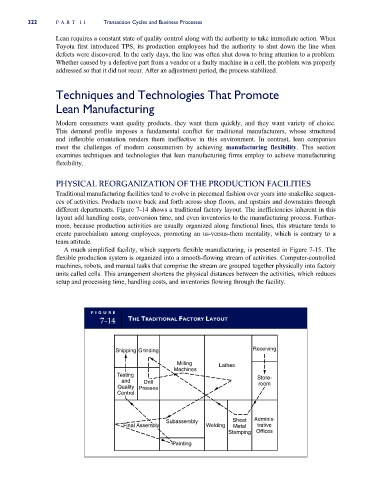
                         Traditional manufacturing facilities tend to evolve in piecemeal fashion over years into snakelike sequen-
                         ces of activities. Products move back and forth across shop floors, and upstairs and downstairs through
                         different departments. Figure 7-14 shows a traditional factory layout. The inefficiencies inherent in this
                         layout add handling costs, conversion time, and even inventories to the manufacturing process. Further-
                         more, because production activities are usually organized along functional lines, this structure tends to
                         create parochialism among employees, promoting an us-versus-them mentality, which is contrary to a
                         team attitude.
                           A much simplified facility, which supports flexible manufacturing, is presented in Figure 7-15. The
                         flexible production system is organized into a smooth-flowing stream of activities. Computer-controlled
                         machines, robots, and manual tasks that comprise the stream are grouped together physically into factory
                         units called cells. This arrangement shortens the physical distances between the activities, which reduces
                         setup and processing time, handling costs, and inventories flowing through the facility.


                                    FI GU RE
                                      7-14     THE TRADITIONAL FACTORY LAYOUT


                                           Shipping  Grinding                       Receiving
                                                             Milling      Lathes
                                                            Machines
                                           Testing                                   Store-
                                             and   Drill                              room
                                           Quality Presses
                                           Control


                                                          Subassembly         Sheet  Adminis-
                                             Final Assembly           Welding  Metal  trative
                                                                             Stamping  Offices
                                                            Painting

