


Page 352 - Accounting Information Systems
P. 352
C H A P TER 7      The Conversion Cycle  323


                                 FI G U R E
                                    7-15    FLEXIBLE PRODUCTION SYSTEM


                                             Sheet                              Finish
                                             Metal      Welding    Machining   Machining
                                              Cell       Cell       Cell #1      Cell


                                           Receiving     Administrative Offices

                                                                             Subassembly

                                            Shipping    Testing  Final Assembly


                       AUTOMATION OF THE MANUFACTURING PROCESS
                       Automation is at the heart of the lean manufacturing philosophy. By replacing labor with automation, a
                       firm can reduce waste, improve efficiency, increase quality, and improve flexibility. The deployment of
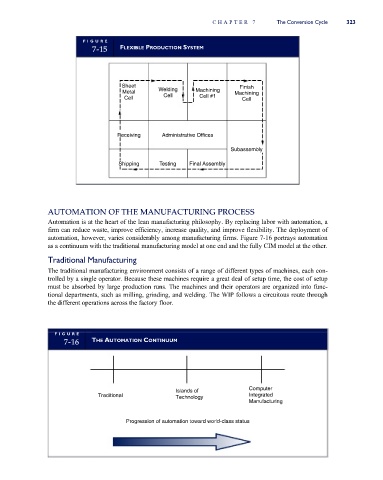
                       automation, however, varies considerably among manufacturing firms. Figure 7-16 portrays automation
                       as a continuum with the traditional manufacturing model at one end and the fully CIM model at the other.

                       Traditional Manufacturing
                       The traditional manufacturing environment consists of a range of different types of machines, each con-
                       trolled by a single operator. Because these machines require a great deal of setup time, the cost of setup
                       must be absorbed by large production runs. The machines and their operators are organized into func-
                       tional departments, such as milling, grinding, and welding. The WIP follows a circuitous route through
                       the different operations across the factory floor.


                         FI G U R E
                           7-16     THE AUTOMATION CONTINUUM


                                                                                   Computer
                                                             Islands of
                                      Traditional            Technology            Integrated
                                                                                   Manufacturing

                                              Progression of automation toward world-class status

