


Page 365 - Accounting Information Systems
P. 365
336     PART II       Transaction Cycles and Business Processes

                 14. How can a firm control against excessive quanti-  18. Explain why traditional cost allocation methods
                     ties of raw materials being used in the manufactur-  fail in a computer-integrated manufacturing
                     ing process?                                   environment.
                 15. What is a value stream map?                19. Explain the concept of a product family and its
                 16. Discuss the advantages of activity-based costing.  relationship to value stream accounting.
                 17. Discuss the disadvantages of activity-based costing.  20. Explain the relationship between MRP II and ERP.


                 Multiple-Choice Questions

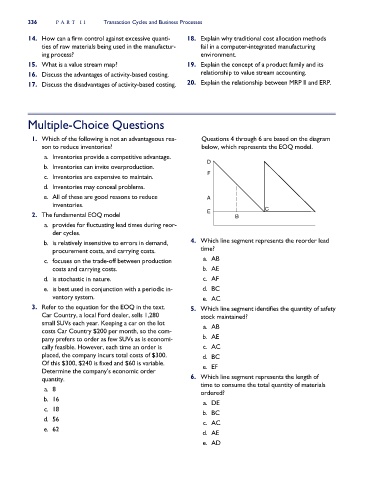
                  1. Which of the following is not an advantageous rea-  Questions 4 through 6 are based on the diagram
                     son to reduce inventories?                      below, which represents the EOQ model.
                     a. Inventories provide a competitive advantage.
                                                                      D
                     b. Inventories can invite overproduction.
                                                                      F
                     c. Inventories are expensive to maintain.
                     d. Inventories may conceal problems.
                     e. All of these are good reasons to reduce       A
                        inventories.
                                                                      E                 C
                  2. The fundamental EOQ model                                 B
                     a. provides for fluctuating lead times during reor-
                        der cycles.
                     b. is relatively insensitive to errors in demand,  4. Which line segment represents the reorder lead
                        procurement costs, and carrying costs.      time?
                     c. focuses on the trade-off between production  a. AB
                        costs and carrying costs.                    b. AE
                     d. is stochastic in nature.                     c. AF
                     e. is best used in conjunction with a periodic in-  d. BC
                        ventory system.                              e. AC
                  3. Refer to the equation for the EOQ in the text.  5. Which line segment identifies the quantity of safety
                     Car Country, a local Ford dealer, sells 1,280  stock maintained?
                     small SUVs each year. Keeping a car on the lot
                                                                     a. AB
                     costs Car Country $200 per month, so the com-
                     pany prefers to order as few SUVs as is economi-  b. AE
                     cally feasible. However, each time an order is  c. AC
                     placed, the company incurs total costs of $300.  d. BC
                     Of this $300, $240 is fixed and $60 is variable.
                                                                     e. EF
                     Determine the company’s economic order
                     quantity.                                   6. Which line segment represents the length of
                                                                    time to consume the total quantity of materials
                     a. 8
                                                                    ordered?
                     b. 16
                                                                     a. DE
                     c. 18
                                                                     b. BC
                     d. 56
                                                                     c. AC
                     e. 62
                                                                     d. AE
                                                                     e. AD

