


Page 376 - Accounting Information Systems
P. 376
C H A P TER 7      The Conversion Cycle  347

                       faulty cost system. Bill asked the team, ‘‘Is ACC begin-  ‘‘Since ACC began accepting small-volume orders,
                       ning to show signs of a faulty cost system?’’      we have had our hands full. Each time we design a
                         Next, the team looked at the manufacturing overhead  new part, a new program must be written. Addition-
                       breakdown (Case 6, Fig. 1). The current cost accounting  ally, it seems the new small-volume parts we are pro-
                       system allocated 100 percent of this overhead to product
                                                                          ducing are much more complex than the large-
                       based on labor dollars. The team felt ACC could do a
                                                                          volume parts we produced just a few years ago. This
                       better job of tracing costs to products based on transac-
                                                                          translates into more moves per run. Consequently,
                       tion volume. Jim explains:
                                                                          we wind up performing AGV maintenance much
                          ‘‘The manufacturing overhead really consists of  more frequently. Sometimes I wish we would get rid
                          the six cost pools shown in Figure 1. Each of these  of those AGVs; our old system of forklifts and opera-
                          activity cost pools should be traced individually to  tors was much less resistant to change.’’
                          products based on the proportion of transactions
                                                                         Sara Nightingale, the most experienced jobsetter at
                          they consume, not the amount of direct labor they
                                                                      ACC, spoke about the current status of setups:
                          consume.’’
                                                                          ‘‘The changeover crew has changed drastically
                         The team conducted the following interviews to
                                                                          recently. Our team has shifted from mostly
                       determine the specific transactions ACC should use to
                                                                          mechanically skilled maintenance people to a
                       trace costs from activities to products.
                                                                          team of highly trained programmers and mechani-
                         John ‘‘Bull’’ Adams, the supervisor in charge of ma-
                       terial movement, provided the floor layout shown in  cally skilled people. This shift has greatly reduced
                       Figure 2 for Case 6 and commented on his department’s  our head count. Yet the majority of our work is
                       workload:                                          still spent on setup labor time.’’


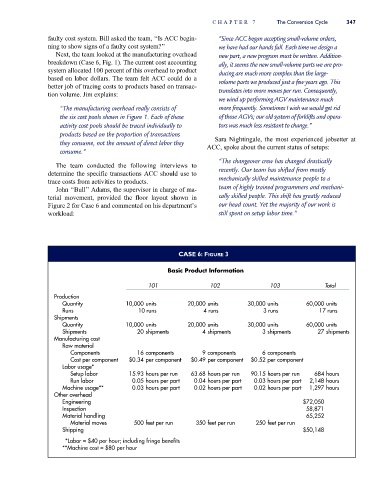
                                                              CASE 6: FIGURE 3

                                                           Basic Product Information
                                                     101               102               103              Total

                        Production
                           Quantity           10,000 units       20,000 units      30,000 units     60,000 units
                           Runs                   10 runs            4 runs            3 runs           17 runs
                        Shipments
                           Quantity           10,000 units       20,000 units      30,000 units     60,000 units
                           Shipments             20 shipments        4 shipments       3 shipments      27 shipments
                        Manufacturing cost
                           Raw material
                             Components          16 components       9 components      6 components
                             Cost per component  $0.34 per component  $0.49 per component  $0.52 per component
                           Labor usage*
                             Setup labor       15.93 hours per run  63.68 hours per run  90.15 hours per run  684 hours
                             Run labor          0.05 hours per part  0.04 hours per part  0.03 hours per part  2,148 hours
                           Machine usage**      0.03 hours per part  0.02 hours per part  0.02 hours per part  1,297 hours
                        Other overhead
                           Engineering                                                             $72,050
                           Inspection                                                               58,871
                           Material handling                                                        65,252
                             Material moves     500 feet per run   350 feet per run  250 feet per run
                           Shipping                                                                $50,148
                            *Labor = $40 per hour; including fringe benefits
                           **Machine cost = $80 per hour

