


Page 302 - Adsorption, Ion Exchange & Catalysis- 2007, Elsevier - Copy
P. 302
Else_AIEC-INGLE_cH004.qxd  7/1/2006  6:53 PM  Page 298
                    298                                          4. Adsorption and Ion Exchange


                    volume of solution was 0.1 L, and the mass of zeolite used w as 2 g.  The zeolite properties
                     ,
                    were: particle size, 1–3 mm; porosity 0.325; and solid density 2.12 (g/cm ,  3  ). The equilib-
                    rium followed the Langmuir isotherm with   Q  M    14.91 mg/g and   K    0.0434 L/mg.
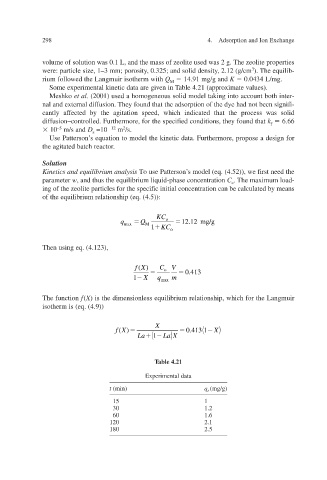
                      Some experimental kinetic data are gi able 4.21 (approximate v alues). T v en in
                      Meshko   et al  . (2001) used a homogeneous solid model taking into account both inter-
                    The fusion.  nal and external dify found that the adsorption of the dye had not been signif i-
                    cantly affected by the agitation speed, which indicated that the process was solid
                    diffusion–controlled. Furthermore, for the specified conditions, they found that   k   6.66
                                                                                     f
                      10  –5  m/s and   D  s  =10    12  m  2  /s.
                      atterson’ Use Ps equation to model the kinetic data. Furthermore, propose a design for
                    the agitated batch reactor .

                    Solution
                    Kinetics and equilibrium analysis   To use Ps model (eq. (4.52)), we first need the atterson’
                    parameter   w , and thus the equilibrium liquid-phase concentration   C . The maximum load- e
                    ing of the zeolite particles for the specific initial concentration can be calculated by means
                    of the equilibrium relationship (eq. (4.5)):


                                                     KC  o
                                          q  max  Q   M     12.12  mg/g
                                                   1  KC    o

                    Then using eq. (4.123),


                                               fX()   C  o  V
                                                             0.413
                                              1  X    q  max  m

                    The function   f ( X ) is the dimensionless equilibrium relationship, which for the Langmuir
                    isotherm is (eq. (4.9))

                                                    X
                                         fX()                 0.413 1     X

                                                    La X 1
                                               La

                                                    Table 4.21
                                                  Experimental data
                                       t (min)                    q (mg/g)
                                                                   t
                                        15                      1
                                        30                       1.2
                                        60                       1.6
                                       120                      2.1
                                       180                      2.5

