


Page 299 - Adsorption, Ion Exchange & Catalysis- 2007, Elsevier - Copy
P. 299
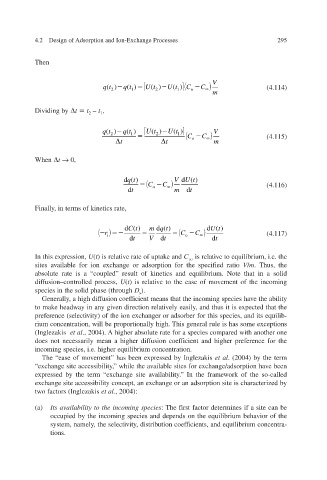
Else_AIEC-INGLE_cH004.qxd  7/1/2006  6:53 PM  Page 295
                  4.2 Design of Adsorption and Ion-Exchange Processes  295


                  Then


                                                                     V

                                     qt ()    1  U t ()    U t ( ) C   1 C              (4.114)
                                          qt ( )
                                                            o
                                        2
                                                   2
                                                                     m
                  Dividing by    t   t –  t , 1
                                 2
                                     qt ()         Ut ()  Ut ( )      V
                                          qt ( )
                                        2    1       2    1   C    C                (4.115)
                                          t            t       o      m
                  When    t →  0,

                                           d( ) qt        V  d( ) Ut
                                                   C    o  C                        (4.116)
                                             d t          m  d t

                  Finally, in terms of kinetics rate,


                                             Ct d( )  m  qt d( )    Ut d( )

                                                             C  o    C              (4.117)
                                      r
                                       i
                                              t d  V   t d            t d
                  In this e xpression,  U ( t ) is relatie rate of uptake and  v  C     is relative to equilibrium, i.e. the
                  sites aailable for ion exchange or adsorption for the specified ratio   V / m . Thus, the
                  v
                  absolute rate is a “coupled” result of kinetics and equilibrium. Note that in a solid
                                              v
                  diffusion–controlled process,  U ( t ) is relatie to the ease of moement of the incoming v
                  species in the solid phase (through   D ).  s
                    Generally, a high dificient means that the incoming species hae the ability f fusion coef v
                   v
                   ,
                  to make headway in any gien direction relatiely easily and thus it is expected that the
                   v
                  preference (selectivity) of the ion exchanger or adsorber for this species, and its equilib-
                  rium concentration, will be proportionally high. This general rule is has some e xceptions
                  (Inglezakis    et al  ., 2004). A higher absolute rate for a species compared with another one
                  does not necessarily mean a higher diffusion coeficient and higher preference for the
                    f
                  incoming species, i.e. higher equilibrium concentration.
                    The “ease of mo has been expressed by Inglezakis   et al  . (2004) by the term
                     v
                     ement”
                  “exchange site accessibility while the aailable sites for exchange/adsorption hae been ,”  v v
                    v
                    ailability
                      w
                  expressed by the term “exchange site a In the frameork of the so-called
                    ”
                    .
                  exchange site accessibility concept, an exchange or an adsorption site is characterized by
                  two factors (Inglezakis   et al  ., 2004):
                  (a)   Its availability to the incoming species  : The first factor determines if a site can be
                      occupied by the incoming species and depends on the equilibrium behavior of the
                       vity
                      system, namely the selecti distribution coef and equilibrium concentra- icients, f
                       ,
                       ,
                      tions.

