


Page 306 - Adsorption, Ion Exchange & Catalysis- 2007, Elsevier - Copy
P. 306
Else_AIEC-INGLE_cH004.qxd  7/1/2006  6:53 PM  Page 302
                    302                                          4. Adsorption and Ion Exchange


                    Solution
                    The finite solution volume model for solid-diffusion control (Ps model) will be atterson’
                    used (eq. (4.52)). Following the procedure presented in the section   Design of a batch reac-
                    tor system for adsorption and ion e hang xc e  (eqs. (4.119)–(4.125)), we obtain the results
                    shown in Table 4.23.
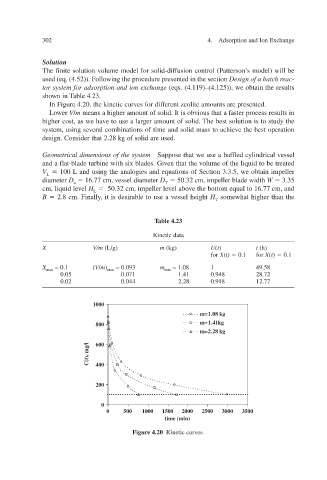
                      In Figure 4.20, the kinetic curves for different zeolite amounts are presented.
                      Lower   V / m means a higher amount of solid. It is obvious that a faster process results in
                     v
                    higher cost, as we hae to use a larger amount of solid. The best solution is to study the
                    system, using seeral combinations of time and solid mass to achiee the best operation v
                     v
                    design. Consider that 2.28 kg of solid are used.
                    Geometrical dimensions of the system  Suppose that we use a baffled cylindrical v essel
                    and a flat-blade turbine with six blades. Gien that the volume of the liquid to be treated v
                    V  L    100 L and using the analogies and equations of Section 3.3.5, we obtain impeller
                    diameter   D  a    16.77 cm, v essel diameter   D  T    50.32 cm, impeller blade width   W    3.35
                    cm, liquid le el  v  H  L    50.32 cm, impeller leel aboe the bottom equal to 16.77 cm, and v
                                       v
                         ,
                    B   2.8 cm. Finally it is desirable to use a vessel height   H  T  somewhat higher than the

                                                    Table 4.23
                                                    Kinetic data
                    X            V/m  (L/g)           m (kg)        U ( t )      t (h)
                                                                    for   X ( t )    0.1  for   X ( t )    0.1
                    X  max  = 0.1  (  V / m )  max  = 0.093  m  min  = 1.08  1  49.58
                         0.05          0.071        1.41  0.948    28.72
                         0.02          0.044        2.28  0.918    12.77


                                   1000
                                                                 m=1.08 kg
                                   800                           m=1.41kg
                                                                 m=2.28 kg

                                   600

                                   400
                                 C(t), mg/l

                                   200

                                     0
                                      0    500  1000  1500  2000  2500  3000  3500
                                                       time (min)
                                              Figure 4.20  Kinetic curv es.

