


Page 309 - Adsorption, Ion Exchange & Catalysis- 2007, Elsevier - Copy
P. 309
Else_AIEC-INGLE_cH004.qxd 7/1/2006 6:53 PM Page 305
4.2 Design of Adsorption and Ion-Exchange Processes 305
Then, the equilibrium liquid-phase dimensionless concentration is estimated following a
trial-and-error procedure, and it is easy to find that X = 0.032. Thus,
C e C X o 0.103 mmol/L
The parameter w is (eq. (4.33))
C C
w o e 0.9679
C o
The roots of eq. 4.58 are a = –3.691 and b = 0.787. Then
C t ()
C
Ut () o
C o C e
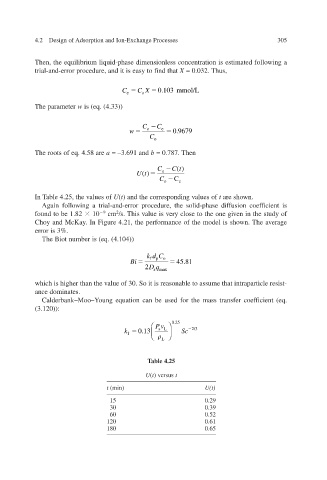
In Table 4.25, the v alues of U ( t ) and the corresponding v alues of t are sho wn.
Again following a trial-and-error procedure, the solid-phase diffusion coeficient is f
found to be 1.82 10 9 cm 2 /s. This value is very close to the one gien in the study of v
Choy and McKay. In Figure 4.21, the performance of the model is shoThe a wn. v erage
error is 3%.
The Biot number is (eq. (4.104))
kd C fp o
Bi 45.81
Dq 2 sma x
which is higher than the value of 30. So it is reasonable to assume that intraparticle resist-
ance dominates.
Calderbank–Moo–Young equation can be used for the mass transfer coeficient (eq. f
(3.120)):
P 0.25
sL
k 0.13 Sc 2/3
f
L
Table 4.25
U ( t ) v ersus t
t (min) U(t)
15 0.29
30 0.39
60 0.52
120 0.61
180 0.65

