


Page 314 - Adsorption, Ion Exchange & Catalysis- 2007, Elsevier - Copy
P. 314
Else_AIEC-INGLE_cH004.qxd 7/1/2006 6:53 PM Page 310
310 4. Adsorption and Ion Exchange
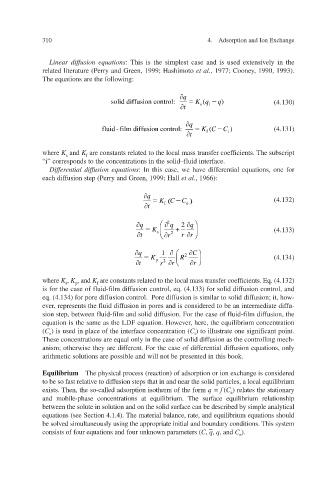
Linear diffusion equations : This is the simplest case and is used eely in the xtensi v
y
related literature (Perry and Green, 1999; Hashimoto et al ., 1977; Coone 1990, 1993).
,
The equations are the follo wing:
q
solid diffusion c : ontrol ( ) Kq s i q (4.130)
t
q
fluid -film diffusion c : ontrol ( ) KC f C i (4.131)
t
where K s and K f are constants related to the local mass transfer coef The subscript icients. f
“i” corresponds to the concentrations in the solid–fluid interf ace.
v
Differential diffusion equations : In this case, we hae differential equations, one for
each diffusion step (Perry and Green, 1999; Hall et al ., 1966):
q
KC ( C ) e (4.132)
f
t
q q 2 2 q
K s + (4.133)
t r 2 r r
q 1 C
K R 2 (4.134)
t p r 2 r r
where K , K , and K f are constants related to the local mass transfer coefficients. Eq. (4.132)
p
s
is for the case of fluid-film diffusion control, eq. (4.133) for solid diffusion control, and
eq. (4.134) for pore diffusion control. Pore diffusion is similar to solid dif ho fusion; it, w-
ever, represents the fluid diffusion in pores and is considered to be an intermediate dif fu-
sion step, between fluid-film and solid diffusion. For the case of fluid-film dif the fusion,
we
,
equation is the same as the LDF equation. Ho here, the equilibrium concentration
er
v
( C ) is used in place of the interface concentration ( C ) to illustrate one significant point. i
e
These concentrations are equal only in the case of solid dif fusion as the controlling mech-
anism; otherwise they are different. For the case of differential diffusion equations, only
arithmetic solutions are possible and will not be presented in this book.
Equilibrium The physical process (reaction) of adsorption or ion exchange is considered
to be so fast relative to diffusion steps that in and near the solid particles, a local equilibrium
exists. Then, the so-called adsorption isotherm of the form q = f ( C ) relates the stationary e
and mobile-phase concentrations at equilibrium. The surface equilibrium relationship
between the solute in solution and on the solid surface can be described by simple analytical
equations (see Section 4.1.4). The material balance, rate, and equilibrium equations should
be solved simultaneously using the appropriate initial and boundary conditions. This system
consists of four equations and four unknown parameters ( C , q , q , and C ). e

